The airend is the mechanical heart of any rotary screw compressor. Inside this precision-engineered component, two helical rotors spin continuously at thousands of revolutions per minute, separated by mere microns of clearance and a continuous film of oil. Because it handles the mechanical workload of continuous gas compression, the airend endures tremendous thermal, axial, and radial forces throughout its operational life. Eventually, every plant manager encounters a critical crossroads: should you rebuild the existing airend, or replace it entirely with a brand-new unit?
Making the wrong call can be disastrous for a production facility. Premature replacement drains capital budgets unnecessarily, while running an aged airend past its operational limit risks catastrophic mechanical failure. If a bearing collapses during operation, the male and female rotors make physical contact, galling the casing, welding surfaces together, and destroying the casting. In that scenario, rebuilding is off the table, downtime spikes, and your only choice is an expensive emergency replacement.
To balance reliability against cost, plant engineers must understand how bearing life degrades, how to calculate remaining useful life using predictive indicators, and how to analyze the financial trade-offs between reconditioning and buying new.
Understanding Bearing Fatigue and the L10 Life Principle
Compressor airends utilize heavy-duty rolling element bearings—typically cylindrical roller bearings on the inlet end for radial loads and angular contact ball or tapered roller bearings on the discharge end to handle both radial forces and high axial thrust. Bearings do not last indefinitely; even under ideal conditions with clean oil and clean air, the cyclic subsurface shear stresses eventually cause microscopic metal fatigue.
In mechanical engineering, bearing longevity is governed by the L10 bearing life calculation. L10 represents the number of operational hours that 90 percent of a group of identical bearings will survive under specific operating conditions before sub-surface fatigue flaking begins. Standard industrial compressor bearings are typically engineered for an L10 life ranging between 40,000 to 60,000 operational hours.
However, theoretical bearing life rarely matches actual plant floor conditions. Several operational stressors accelerate fatigue and reduce the true service life:
- Excess Operating Discharge Temperature: Extreme heat degrades the lubricant film thickness, accelerating metal-to-metal micro-welding. Facilities battling ambient heat issues, such as those seeing why screw compressors overheat in south tamil nadu summers and how to fix it, often experience accelerated lubricant oxidation and reduced bearing life.
- Discharge Pressure Levels: Operating a machine above its design pressure significantly increases the axial thrust load on the discharge bearings. Understanding why operating above 7 bar wastes power sizing header pressure to match tool requirements is critical not just for energy conservation, but also for preventing premature bearing overload.
- Particulate Contamination: In harsh industrial plants, fine abrasives can slip through degraded air filters, contaminating the oil and acting as a lapping compound on bearing races. In environments such as foundries, addressing pneumatic requirements for sand casting foundries protecting compressors from silica dust and abrasives is essential to protect the compression chamber.
- Moisture and Varnish: Water in the oil reduces hydrodynamic film strength, causing micro-pitting and corrosion on raceways.
Predictive Diagnostics: Calculating Remaining Bearing Life
Rather than relying solely on run-hour meters, plant operators should evaluate the true remaining useful life of their bearings through predictive diagnostic monitoring. Relying purely on chronological age can lead to either premature overhaul or unanticipated lock-up.
1. Vibration Analysis and Demodulation: Vibration monitoring is the most accurate method to evaluate bearing fatigue. Standard overall vibration velocity (measured in millimeters per second or inches per second) detects imbalance, misalignment, and looseness. However, high-frequency acceleration enveloping (peak vue or demodulation) identifies microscopic subsurface defects and surface spalling on bearing raceways long before standard vibration spikes. Tracking bearing defect frequencies (BPFI, BPFO, BSF, and FTF) indicates the progression of wear from initial micro-fatigue to advanced surface damage.
2. Oil Analysis and Ferrography: Routine oil samples detect elevated levels of wear metals like iron, bronze, and chromium. Analytical ferrography reveals the shape and size of metal debris: small, rub-wear particles represent standard aging, while large, laminar fatigue flakes indicate the bearing raceway has begun to spall, meaning remaining life is measured in weeks or days rather than months.
3. Axial and Radial Clearance Verification: During routine service inspections, technicians can manually inspect axial float and radial play with dial indicators. As bearings wear, clearance increases, shifting the rotors out of position. Increased rotor clearance often correlates with noticeable changes in output capacity and efficiency, accompanied by oil degradation and symptoms of oil carryover in rotary screw compressors and how to prevent product contamination as thermal loads rise.
Airend Rebuilding: Scope, Execution, and Viability
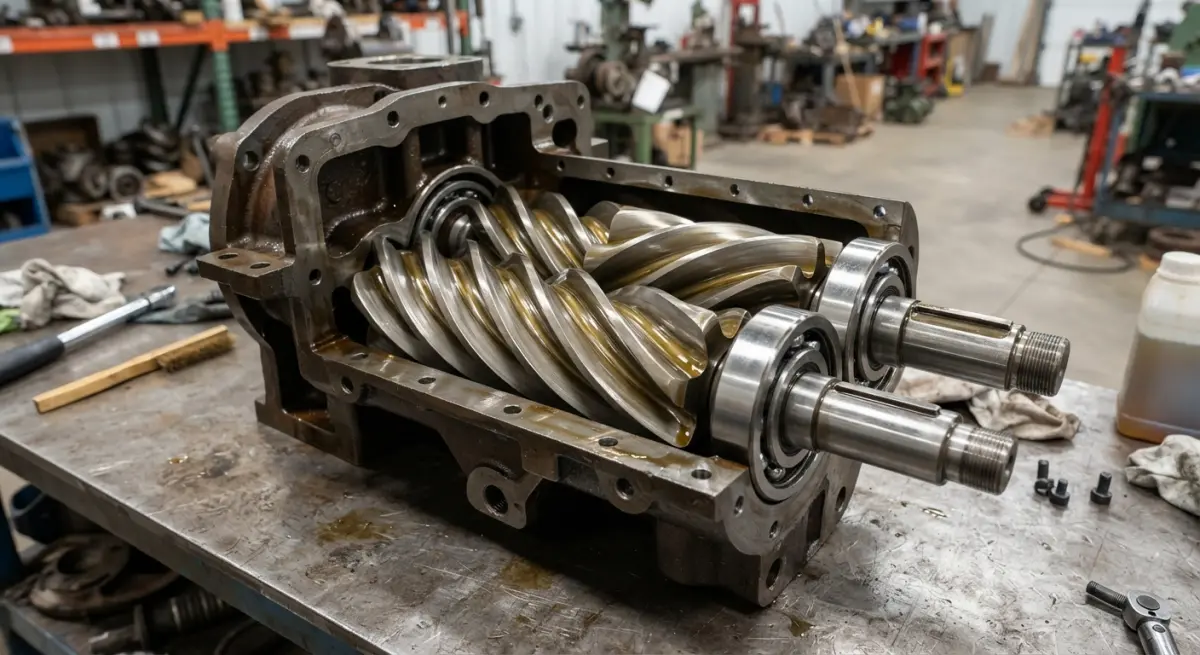
A precision airend overhaul is not simply a field bearing swap. It is a specialized, cleanroom-grade remanufacturing process. A proper rebuild requires:
- Complete teardown and chemical cleaning of rotors and housing.
- Non-destructive crack detection (magnetic particle or dye penetrant inspection) on rotor shafts.
- Precision measurement of housing bores for ovality and taper.
- Inspection of rotor lobes for cavitation, scoring, or thermal damage.
- Installation of matched pairs of precision-ground bearings with correct contact angles and preload.
- Replacement of internal oil seals, shaft sleeve seals, and PTFE wear rings.
- Exact shimming to restore original factory discharge port clearances and rotor-to-housing end play.
When to Rebuild: Rebuilding is the preferred route when the intervention is planned proactively based on run hours or early vibration indicators. If the compressor is pulled while the casing and rotors are completely intact, rebuilding restores the unit to like-new operational tolerances at a fraction of the cost of a complete replacement.
Airend Replacement: When New Is the Only Safe Path
While rebuilding is cost-effective, certain mechanical thresholds dictate that a replacement is the only viable option:
- Rotor or Housing Contact: If bearing collapse allowed the rotors to strike the end plate or rub against each other, the resulting galling and severe gouges alter profile clearances permanently. Machining away gouges widens rotor-to-housing clearances, causing severe internal blow-hole leakage that drastically reduces CFM delivery and energy efficiency.
- Shaft Fretting or Fatigue Cracks: If bearing outer rings have spun in the housing bores, or inner races have spun on the drive shaft, the structural integrity of the casting or shaft is compromised. Sleeving or thermal spraying can fix minor journal wear, but severe wear often compromises rotational balance and concentricity.
- Airend Obsolescence: On older generation compressors, updated profile geometries deliver substantially better specific energy consumption (kW per CFM). Replacing the complete airend assembly with a current-generation unit may offer long-term energy savings that justify the initial capital expense.
Financial Framework: Comparing Rebuild vs. Replacement Costs
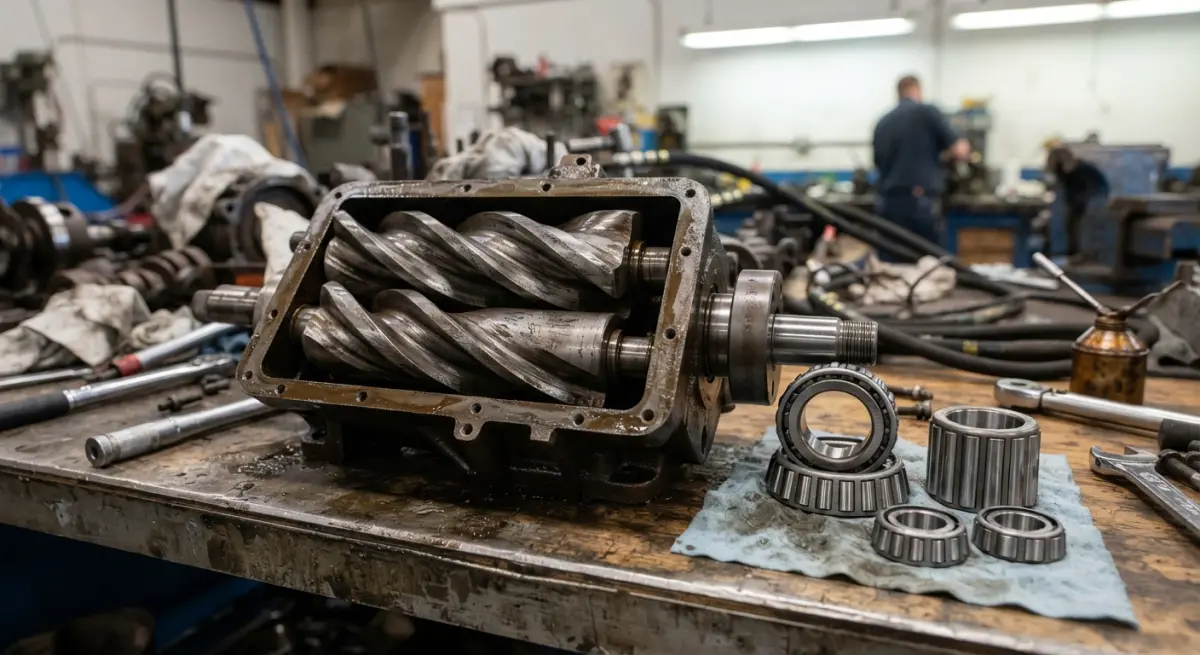
To determine the most economical option, balance immediate capital expenditure against operational risk and asset lifecycle.
Cost Comparison Checklist:
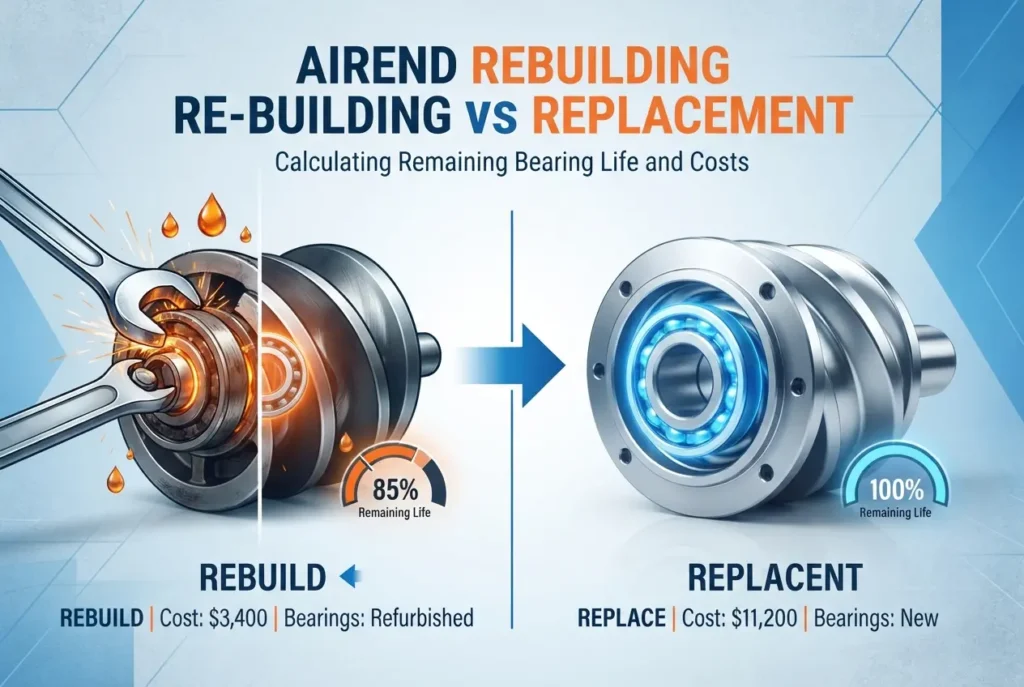
- Rebuilding Expenses: Specialized labor, precision bearing sets, dynamic balancing, precision seals, machine-shop shimming, freight, and diagnostic sign-off. Rebuilding generally costs roughly 35% to 55% of the price of a brand-new factory airend.
- Replacement Expenses: Complete replacement module, mounting adaptations, core-exchange credit or surcharge, and original equipment manufacturer logistics.
- Downtime Factor: A complete replacement airend can often be swapped quickly if a drop-in unit is sitting on the floor. An off-site precision rebuild may take two to four weeks depending on bearing availability and machining requirements. If production downtime costs exceed the cost difference between the two solutions, a factory replacement (or utilizing a swing unit) may be necessary.
- Warranty Terms: Always compare the warranty. Professional rebuilders provide warranties on parts and labor for rebuilt units, while new factory airends typically carry standard multi-year OEM warranties.
Practical Example: Making the Decision on the Shop Floor
Consider a typical industrial facility operating a 75 kW oil-injected rotary screw compressor running 24/7. The machine reaches 42,000 run hours. Periodic vibration analysis flags high-frequency peak acceleration values on the discharge-end angular contact thrust bearings. Oil analysis remains clean, and overall mechanical vibration has not yet climbed into alarm thresholds. Visual inspection reveals no rotor rubbing.
In this scenario, scheduling a controlled shutdown to rebuild the airend is the most cost-effective path. Because the rotors and housing bores have suffered zero damage, a clean rebuild restores bearing clearances to factory tolerances, preventing an unplanned catastrophic failure that would force an emergency purchase, lengthy downtime, and double the repair bill.
Conversely, if an unmonitored machine operates until high-pitch screeching occurs, resulting in a sudden thermal overload shutdown, rotors will have crashed into the casing. At that point, rebuilding is an unviable compromise, and total replacement is unavoidable.
Taking control of your compressed air lifecycle requires shifting from reactive repairs to predictive maintenance. By monitoring bearing degradation frequencies, tracking running hours, and scheduling overhauls before physical rotor damage occurs, facility managers keep maintenance costs predictable and capital assets operating reliably.
If your screw compressor is approaching high operational hours or displaying elevated vibration levels, contact the engineering team at SK Air Solutions. Our specialists provide precision diagnostics, predictive vibration monitoring, complete airend rebuilds, and genuine replacement assemblies to keep your operations running at peak efficiency.
Frequently Asked Questions
How do you calculate the L10 bearing life of a rotary screw airend?
Calculating L10 bearing life involves evaluating dynamic load ratings, operational speed (RPM), and actual discharge pressure against the manufacturer's bearing fatigue formulas. Technicians use this data alongside oil sample analyses to estimate the remaining hours before a catastrophic failure is statistically likely to occur.
What are the primary symptoms indicating an airend needs rebuilding instead of routine maintenance?
Key warning signs include elevated vibration signatures detected during spectral analysis, increased operating temperatures, and metallic debris appearing in the oil filter. A noticeable drop in CFM output combined with a whining or rumbling noise typically indicates rotor contact or severe bearing fatigue.
What is the cost comparison between rebuilding a rotary screw airend and total replacement?
A professional airend rebuild typically costs 40% to 60% less than purchasing a brand-new OEM replacement unit. However, if rotor profiles are severely scored or the housing is cracked, the machining costs can escalate, making a complete replacement the more cost-effective option.
How many operating hours can a properly rebuilt rotary screw airend last?
A precision-rebuilt airend that includes new OEM-spec bearings, dynamic rotor balancing, and restored clearances can last between 40,000 to 60,000 additional operating hours. Achieving this lifespan requires strict adherence to recommended lubrication schedules and operating within rated temperature limits.
When does replacing an entire compressor make more financial sense than an airend rebuild?
Replacement is generally recommended if the compressor is over 15 years old, uses obsolete fixed-speed technology, or requires ancillary repairs like a new motor and cooler alongside the airend. In these cases, the energy efficiency gains and warranty coverage of a modern VFD compressor outweigh the savings of a rebuild.