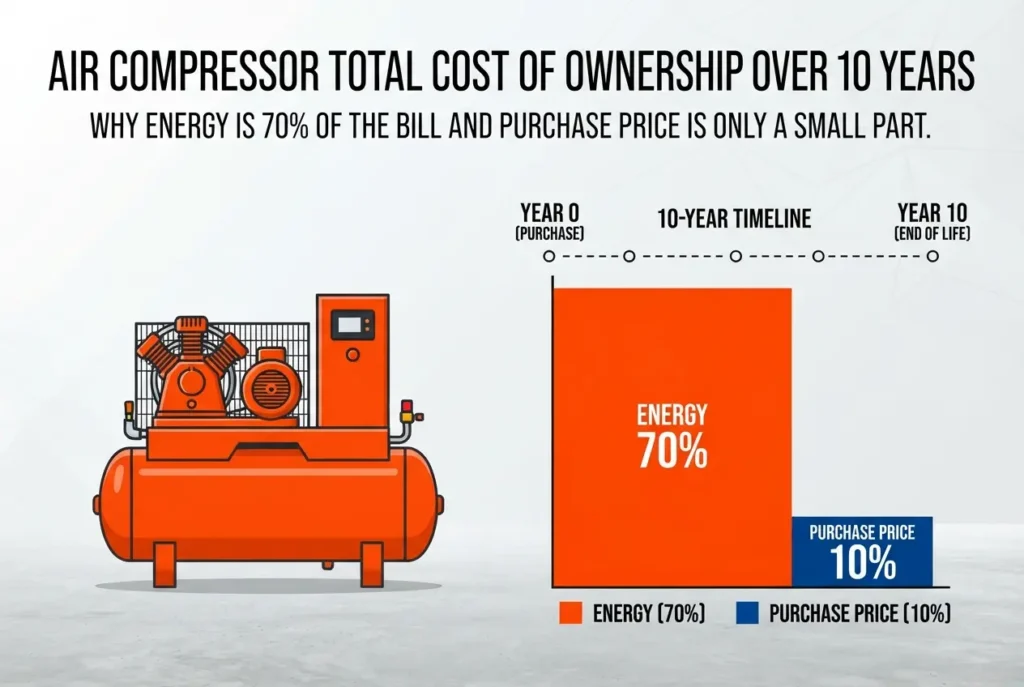
Ask most buyers what an air compressor costs and they will quote the invoice. That number is easy to compare, easy to negotiate, and easy to approve. It is also one of the least important numbers in the whole equation. Over a ten-year life, the electricity a compressor consumes typically dwarfs everything else you spend on it, which is why the commonly cited rule of thumb puts energy at roughly 70 percent of lifetime cost.
The exact split varies with running hours, tariff, load profile and how well the system is looked after. But the pattern holds across almost every industrial plant: the purchase price is a small slice, maintenance is a modest slice, and power is the bulk of the bill. A cheaper machine that is less efficient can quietly cost you far more than a better one.
This post walks through where the money actually goes, why energy dominates, and what you can do about it before and after you buy. If you are planning a purchase, our air compressors and compressed-air products range is a useful reference as you read.
Where the Money Goes Over Ten Years
Think of total cost of ownership (TCO) as four buckets: the initial purchase and installation, energy, maintenance and consumables, and downtime or production risk. The first bucket is a one-time event. The second runs every hour the motor turns.
A compressor in a plant running multiple shifts may operate thousands of hours every year. A motor drawing a large amount of electrical power for that many hours, year after year, accumulates a power bill that quickly passes the cost of the machine itself. In many plants, the energy spend can exceed the purchase price within the first year or two of operation.
Maintenance matters too, but it is predictable and controllable. Filters, oil, separators, belts and service visits are planned costs. A structured air compressor service and AMC in South Tamil Nadu arrangement keeps them predictable and protects efficiency, since a neglected machine uses more power to deliver the same air.
Why Energy Dominates the Bill
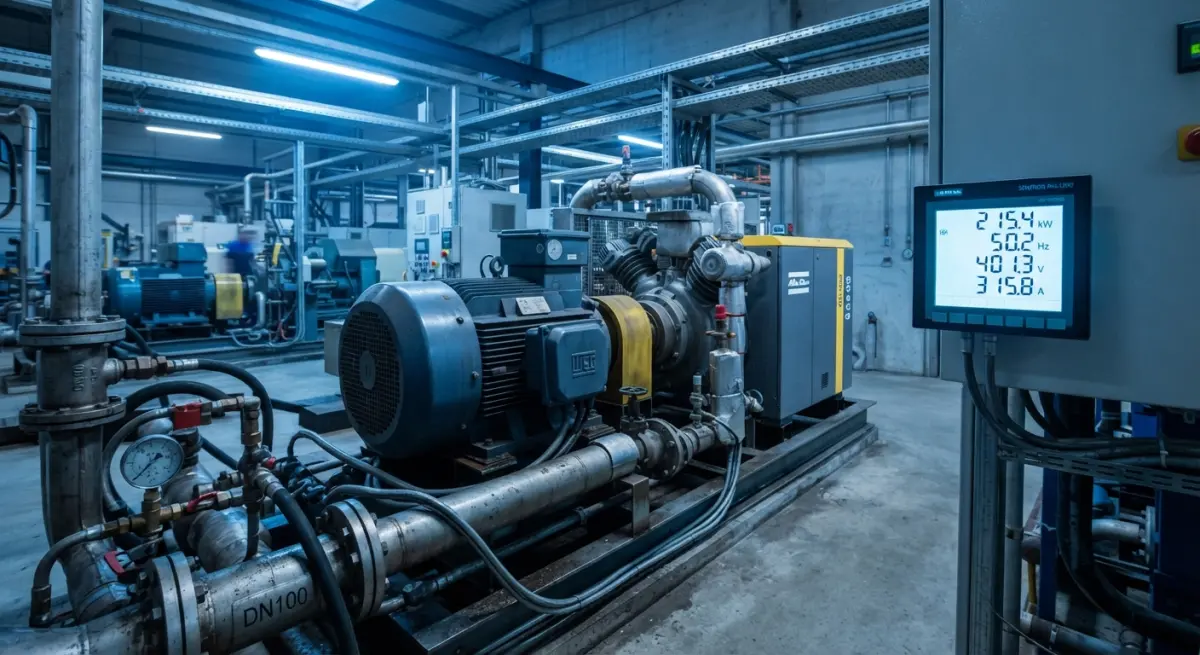
Compressing air is inherently energy-hungry, and much of the electrical input is converted to heat rather than useful pressure. That means every wasted unit of compressed air carries a real electricity cost behind it. Several factors push the energy share up:
- Running hours: Continuous or multi-shift operation multiplies every inefficiency.
- Unloaded running: Fixed-speed machines keep drawing significant power while idling without delivering air. Learning how to measure and mitigate unloaded running hours on fixed-speed industrial compressors can expose a surprising amount of waste.
- Excess pressure: Every extra bar of discharge pressure raises power consumption. See why operating above 7 bar wastes power for the reasoning.
- Leaks: Air escaping through fittings and hoses is paid for in full but produces nothing.
- Poor piping and pressure drop: Undersized or badly laid-out distribution forces the compressor to run at higher pressure to compensate.
Choosing the Machine With the Whole Decade in Mind
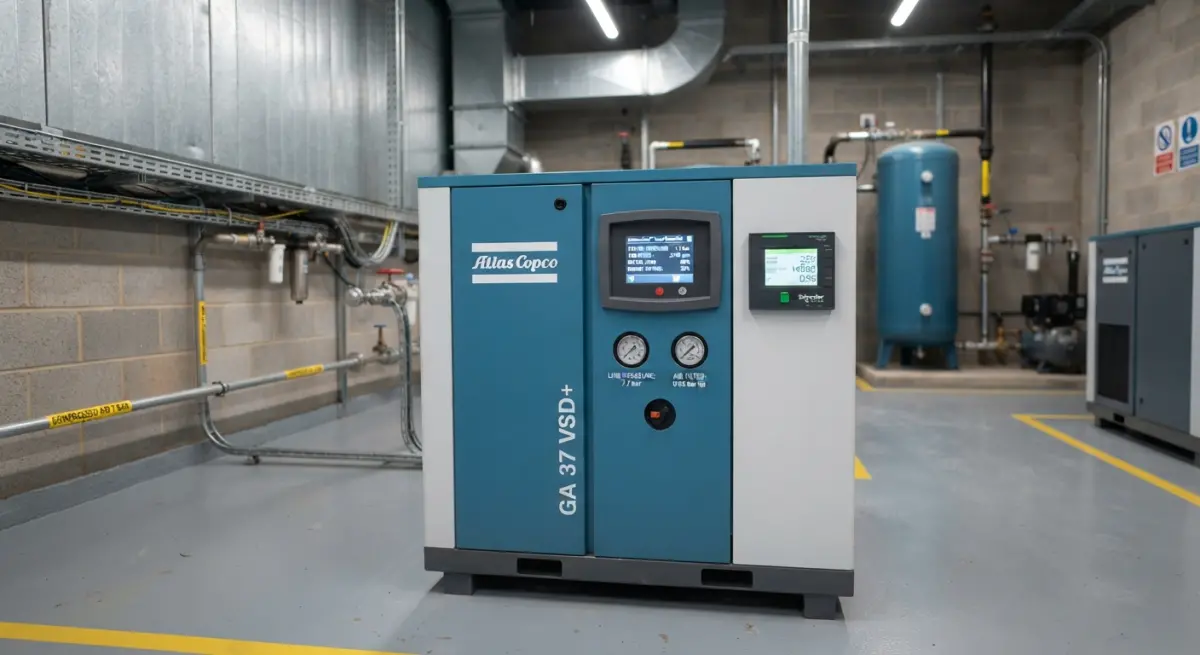
Because energy is the dominant cost, efficiency at your actual load matters more than the headline price. Plants with fluctuating demand often benefit from variable-speed drives, which match motor output to air demand instead of idling. Our comparison of fixed-speed vs VFD air compressors explains when the higher upfront cost pays back.
Sizing is the other big lever. An oversized machine runs unloaded or short-cycles, while an undersized one runs flat out and runs hot. Start with a proper demand calculation using how to calculate air compressor CFM for your factory. If uptime is critical, it is also worth weighing one large compressor or two smaller units, since two machines can follow demand more efficiently and give you backup.
Environment plays a part as well. Hot, dusty conditions raise operating temperatures and strain the machine. Good ventilation helps, and our compressor room ventilation guide for South Tamil Nadu factory sheds covers the practical details.
Practical Ways to Cut the Energy Share
You do not need a new compressor to start saving. Work through these steps in order:
- Find the leaks. An ultrasonic survey is quick and usually pays for itself. Here is how to conduct an ultrasonic compressed air leak audit.
- Lower the header pressure. Set pressure to what your tools genuinely need, plus a sensible margin for pressure drop.
- Replace wasteful drains. Timer drains can blow air along with condensate. Compare options in zero-air-loss condensate drains vs timer drains.
- Measure before you replace. If a machine is ageing, check its efficiency first. How to measure compressor specific power gives you the data to decide.
- Keep up with maintenance. Clogged filters and degraded oil quietly increase power draw.
A Simple Way to Think About It
Imagine two compressors of the same capacity. One is cheaper to buy but uses slightly more power for every unit of air it delivers. Because it runs for years, that small difference repeats thousands of hours over, and the extra electricity cost can easily outweigh the savings on the invoice. The more efficient machine, even at a higher price, often becomes the cheaper one well before the ten-year mark.
The same logic applies to accessories. Better filtration, correct dryers and well-designed piping may add to the initial quote, but they reduce pressure drop, protect equipment and keep the compressor from working harder than it needs to.
Conclusion
The purchase price is the visible part of an air compressor’s cost, but energy is the part that quietly runs the budget. Judge a compressor by what it will cost across a decade: efficiency at your real load, correct sizing, sensible pressure, a tight distribution system and disciplined maintenance. Do that, and you shift spending from wasted electricity back into your business.
If you want help modelling the lifetime cost of your compressed-air system, request an air compressor quote from our team. We will help you compare options on total cost, not just price, and you can find more practical advice in our air compressor guides and insights.
Frequently Asked Questions
What percentage of an air compressor's 10-year total cost of ownership is energy?
Energy typically accounts for about 70-80% of an industrial air compressor's lifetime cost, especially for units running multiple shifts. Maintenance usually adds 10-15%, while the initial purchase price and installation make up only around 10-15%. Because electricity dominates the bill, even a small gain in efficiency can save far more than a lower sticker price.
How do I calculate the total cost of ownership for an air compressor over 10 years?
Add the purchase and installation cost, the 10-year energy cost (kW input × operating hours per year × electricity rate × 10), and the 10-year maintenance cost, including filters, oil, service kits, and downtime. Then add any costs for leaks, compressed air treatment such as dryers, and expected end-of-life or overhaul expenses. Comparing this total across models shows the real cost of each option, not just the upfront price.
Why is a cheaper air compressor often more expensive in the long run?
Lower-priced compressors often use less efficient airends, motors, and controls, so they consume more kWh for each cubic foot of air delivered. Over thousands of operating hours per year, that extra power use can exceed the original price savings within the first two or three years. They may also have higher maintenance needs and shorter service lives, which raises the lifetime cost further.
What are the best ways to reduce air compressor energy costs?
The biggest savings come from fixing air leaks, lowering system pressure to what's actually needed, and installing a variable speed drive (VSD) compressor when demand fluctuates. Proper sizing, central controls, and heat recovery systems also help, since much of the electricity used is converted to heat that can be reused. Regular maintenance of filters and separators prevents pressure drops that force the compressor to work harder.
Is a variable speed drive (VSD) air compressor worth the higher purchase price?
A VSD compressor is usually worth it when air demand varies significantly, because it matches motor speed to demand and avoids the energy waste of running unloaded. This can cut energy use by 20-35% compared with a fixed-speed unit, often paying back the extra cost in one to three years. If demand is constant and near full capacity, a fixed-speed unit may be equally cost-effective.