
Water in a compressed-air system is not unusual—it is the natural result of compressing humid atmospheric air. The problem begins when that moisture reaches piping, pneumatic equipment, paintwork, instruments or the production process.
A refrigerated air dryer removes much of the water vapour that would otherwise condense downstream. For many indoor factories and workshops, it is the practical first level of moisture control between the compressor and the machines.
Short answer: if your plant sees water at drain points, corrosion in air lines, sticking pneumatic components or moisture-sensitive production problems, the compressor system needs better separation, drainage and drying—not simply a larger compressor.
Why compressed air contains water
The air entering a compressor always contains water vapour. Compression concentrates that moisture. The discharge air is hot, so much of the water remains as vapour initially. As the air passes through an aftercooler, receiver and factory piping, it cools and the vapour begins to condense into liquid water.
A moisture separator and automatic drains can remove liquid condensate, but they do not remove all remaining water vapour. Without a dryer, more condensation can form later as the air cools further in the distribution system.
How a refrigerated air dryer works
A refrigerated dryer lowers the temperature of the compressed air in a controlled heat exchanger. Cooling causes water vapour to condense. The liquid is separated and discharged through a drain, and the dried air is reheated before entering the downstream system.
This process gives the air a controlled pressure dew point. In simple terms, the downstream air must cool below that dew point before additional liquid water forms. Refrigerated dryers are commonly selected for indoor industrial applications where extremely low sub-zero dew points are not required.
What moisture can do inside a factory
- Corrode steel receivers and air-distribution piping
- Wash lubrication from pneumatic tools and cylinders
- Cause control valves and instruments to stick or malfunction
- Damage paint finishes and surface-preparation work
- Carry rust, water and contamination toward the point of use
- Increase maintenance and unplanned production interruptions
- Affect packaging, product quality or process repeatability
The severity depends on the application. A general workshop may tolerate a different air-quality level from food processing, electronics, instrumentation or a product-contact process. Air treatment should therefore be selected around the actual risk.
Signs your plant may need better air drying
- Water repeatedly appears at point-of-use drains.
- Hoses or tools discharge a visible mist.
- Internal piping develops rust or scale.
- Pneumatic cylinders become sluggish or unreliable.
- Paint, coating or finishing quality changes with weather.
- Condensate increases during hot and humid periods.
- The existing dryer shows a high dew-point or temperature alarm.
These symptoms can also involve failed drains, dirty coolers, undersized filters, excessive inlet temperature or overloaded equipment. The complete system should be checked rather than assuming the dryer alone is at fault.
How to size a refrigerated dryer correctly
Do not select a dryer only by matching its catalogue CFM to the compressor’s nominal output. Dryer capacity changes with operating conditions. The important inputs include:
- Maximum airflow through the dryer
- Maximum working pressure
- Compressed-air inlet temperature
- Compressor-room ambient temperature
- Required pressure dew point
- Expected pressure loss
- Operating hours and seasonal conditions
High inlet or ambient temperature can reduce the effective capacity of a refrigerated dryer. Use the manufacturer’s correction factors for the actual installation and select against the worst credible operating condition, not only a mild-day average.
Where the dryer fits in the complete air system
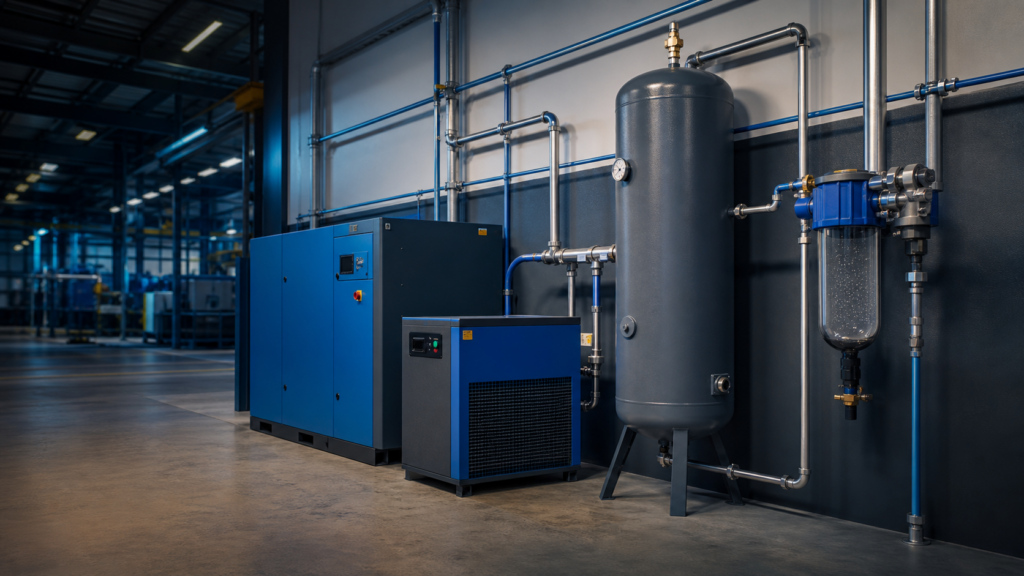
A typical system includes the compressor, aftercooling and moisture separation, an air receiver, the dryer, filters, drains and distribution piping. Exact order and filtration depend on the compressor, dryer design and required air quality, so follow the equipment manufacturer’s installation guidance.
| Component | Primary job |
|---|---|
| Screw compressor | Produces compressed airflow at the required pressure |
| Air receiver | Stores air, settles condensate and stabilises demand |
| Refrigerated dryer | Reduces water vapour and downstream condensation |
| Downstream filters | Remove particles and aerosols to the required level |
| Air piping | Distributes treated air with acceptable pressure loss |
A dryer does not replace filters or drains
Drying and filtration solve different problems. The dryer controls water vapour. Filters remove solid particles, oil aerosols and other contaminants according to their grade. Automatic drains remove collected liquid from separators, receivers, filters and the dryer.
A failed drain can send accumulated water downstream even when the dryer itself is operating correctly. Include drains and filter differential pressure in routine inspections.
When a refrigerated dryer may not be enough
Some processes require a pressure dew point below the capability of a refrigerated dryer. Air lines exposed to temperatures below the dryer’s dew point can also form condensation again. In those cases, a desiccant or another specialised drying method may be required.
- Instrumentation requiring very dry air
- Outdoor or cold-area piping where freezing is possible
- Critical product-contact applications
- Processes with a specified low dew-point requirement
Refrigerated dryer maintenance checklist
- Check the dew-point or evaporator-temperature indication.
- Confirm condensate drains cycle and discharge correctly.
- Keep condenser surfaces and ventilation paths clean.
- Inspect for abnormal refrigerant-circuit alarms.
- Confirm inlet temperature and airflow remain within rating.
- Check filters for excessive differential pressure.
- Keep hot compressor exhaust away from the dryer air intake.
Frequently asked questions
Does every screw compressor need a dryer?
Not every application has the same air-quality requirement, but many factories benefit from controlled moisture removal. The decision should reflect the process, piping temperature and consequences of downstream water.
Should dryer CFM equal compressor CFM?
The dryer must handle the maximum actual airflow, but its nominal rating must also be corrected for inlet temperature, ambient temperature and pressure. A simple one-to-one catalogue comparison can be misleading.
Will a larger air receiver remove moisture?
A receiver can cool the air and collect some condensate, but it does not provide a controlled pressure dew point. It complements a dryer rather than replacing one.
Select the complete air-treatment package
SK Air Solutions supplies VAYU compressors, refrigerated dryers, air receivers, downstream filters and complete compressed-air systems across Madurai and South Tamil Nadu. We can review airflow, pressure, temperature, air quality and installation conditions before selecting equipment.
Request an air-treatment review, call 97900 27123, or WhatsApp 77080 79308 with your compressor model, flow, pressure and current moisture problem.
Also read: Zero-Air-Loss Condensate Drains vs Timer Drains: ROI and Air Wastage Breakdown