
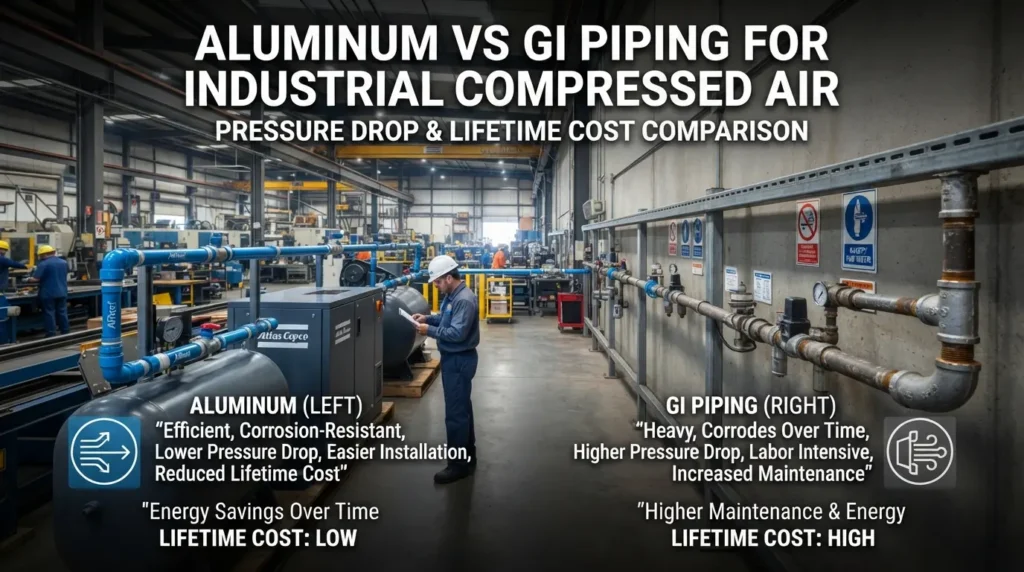
When setting up or retrofitting an industrial compressed air distribution network, plant managers often spend weeks evaluating compressor capacities, motor efficiencies, and filtration levels. Yet, all too often, the piping distribution network is treated as an afterthought. Piping is the vascular system of your facility; choosing the wrong material can strangle performance, lead to chronic pressure drops, and inflate operating costs for decades.
Historically, Galvanized Iron (GI) piping served as the default standard across Indian manufacturing floors. It was readily available, structurally rigid, and familiar to local plumbers. However, modern manufacturing demands higher energy efficiency and superior air purity. This shift has placed modular aluminum piping systems at the forefront of compressed air distribution design.
Deciding between aluminum and GI piping requires looking beyond upfront material quotes. A thorough comparison of internal friction, long-term corrosion resistance, installation complexity, and overall lifecycle expenditure shows why progressive plants are rethinking their air headers. Evaluating these factors helps determine the right framework for reliable, long-term operation.
Understanding the Mechanics: Pressure Drop and Friction
Pressure drop is the loss of air pressure between the compressor discharge manifold and the actual point of consumption. Every bend, valve, and foot of rough pipe surface introduces resistance against the moving stream of compressed air. When friction within the pipe reduces downstream delivery pressure, plant operators typically compensate by increasing the discharge pressure at the compressor.
Generating air at higher pressures requires significantly more electrical energy. If your distribution system suffers from heavy friction, your compressor continuously consumes excessive power merely to overcome the piping resistance. This mechanical burden impacts your bottom line every minute the machine runs.
This is where internal pipe topography becomes decisive. Extruded aluminum pipes feature calibrated, mirror-smooth internal bores. In contrast, GI pipes possess a naturally rough, uneven interior created during the galvanization process. Over time, that initial roughness worsens dramatically as the protective zinc coating reacts with moisture and heat, creating micro-turbulences that steadily amplify pressure drop.
The Corrosion Factor: Cleanliness and Downstream Impact
Untreated compressed air contains moisture, oil vapors, and heat. Even when an air system incorporates moisture separators, trace moisture inevitably finds its way into distribution headers. When moisture contacts the inner walls of a GI pipe, corrosion is inevitable.
The interior zinc layer of a GI line eventually deteriorates, exposing raw iron. As rust scales off, it migrates down the line as abrasive particulate debris. This debris clogs particulate filter elements, fouls pneumatic solenoid valves, damages cylinder seals, and ruins finished products in sensitive operations such as painting, electronics assembly, or food packaging. Understanding why factories need a refrigerated air dryer highlights how critical clean, dry air is, but downstream pipe corrosion can negate drying efforts if the pipe itself breaks down.
Aluminum piping is non-corrosive. High-grade aluminum alloys naturally develop a protective oxide film that prevents rust and corrosion. As a result, the air exiting an aluminum line remains as clean as the air entering it, preserving downstream pneumatic tools and ensuring that production processes run without contamination.
Installation Speed, Weight, and Structural Demands
The initial purchase price of bare aluminum pipe is higher than that of GI pipe, leading some facilities to make purchase decisions solely on material invoices. However, looking at total installed cost tells a different story.
Installing GI piping is labor-intensive, slow, and mechanically demanding. Steel pipes require cutting, manual or mechanical threading, solvent application, and heavy wrenches. Pipe threads are common failure points; improper threading frequently leads to persistent micro-leaks. Furthermore, steel is exceptionally heavy, necessitating robust ceiling anchors, structural supports, and multiple technicians just to hoist and position a single header length.
Modular aluminum systems use push-to-connect fittings, compression collars, or mechanical grooved couplings. Pipes are cut square, deburred, and assembled rapidly without hot work permits, threading machines, or messy sealants. Because aluminum is roughly one-third the weight of steel, handling is faster and requires fewer structural supports. In many factory builds, the drastically reduced labor hours offset the initial material price difference.
Total Cost of Ownership: A Long-Term Assessment
To make a sound financial decision, evaluate your distribution network across its entire working lifespan rather than merely tracking Day One expenses. The financial comparison between aluminum and GI rests on three main pillars:
- Air Leaks: Threaded GI joints are notorious for developing leaks as facilities vibrate and cycle through thermal expansion. Compressed air leaks force compressors to run continuously, driving up utility bills. Aluminum push-fit or compression systems utilize engineered nitrile or NBR O-rings that maintain airtight seals despite building vibration.
- Maintenance and Modification: Manufacturing floors evolve. Adding a new drop to an existing GI loop often requires shutting down the line, unthreading large sections, cutting steel, and re-threading. Modular aluminum systems allow drops to be added quickly using clamp-on saddle fittings without disassembling the main line.
- Compressor Energy Consumption: Because an aluminum network maintains low friction and zero internal scale buildup, the compressor discharge pressure can be dialed down closer to actual tool requirements. Running a compressor at a lower operating pressure yields persistent, facility-wide electricity savings month after month.
Whether you manage operations using air compressors in madurai or operate heavy industrial plants in neighboring districts, choosing piping that preserves energy efficiency ensures your utility spending translates directly into productive factory output.
Practical Tips for Planning Your Compressed Air Network
Upgrading or installing an air line requires strategic planning. Keep these operational guidelines in mind before sourcing materials:
- Design a Closed Loop: Avoid straight dead-end runs when possible. A ring main (closed loop) allows air to flow in two directions toward high-demand equipment, cutting localized pressure drop in half.
- Size for Velocity, Not Just Volume: Never choose pipe diameter purely based on the compressor’s outlet port. Calculate velocity to ensure air travels within recommended operational limits; excessively small lines generate severe friction regardless of pipe material. First learn how to calculate air compressor cfm for your factory to size your network accurately.
- Use Overhead Loops with Goose-Neck Drops: Take air off the top of the main distribution line using goose-neck bends. This design prevents accumulated condensation from draining directly into tools and workstations.
- Audit for Leaks Regularly: Regardless of your chosen material, implement routine ultrasonic leak audits. Eliminating small hisses around hoses, quick couplers, and valves protects your compressor from unnecessary cycling.
Making the Right Choice for Your Plant
While GI piping may seem like an economical option on paper, its hidden costs—high friction, rust formation, costly installation labor, and recurring leaks—make it expensive over time. For modern facilities focused on energy conservation, low maintenance, and air cleanliness, modular aluminum piping is the superior engineering and financial solution.
A properly engineered distribution network protects your machinery, keeps production lines moving, and prevents your utility bills from spiraling out of control. If you are planning an upgrade, building a new facility, or auditing an older distribution system, the experienced team at sk air solutions can assist you with comprehensive sizing, layout optimization, and system selection.
Ready to upgrade your compressed air distribution network? Reach out to request an air compressor quote and discover how modular piping systems can elevate your plant’s efficiency.
Frequently Asked Questions
How does compressed air pressure drop compare between aluminum and GI piping over time?
Aluminum piping maintains a smooth inner surface with an absolute roughness of about 0.0015 mm, resulting in minimal friction and a consistently low pressure drop throughout its lifespan. In contrast, Galvanized Iron (GI) pipes have an initial roughness of roughly 0.15 mm that worsens over time as moisture causes internal corrosion and scale buildup, significantly increasing pressure drop. This escalating resistance in GI systems forces air compressors to work harder, dramatically increasing operating energy demands.
Why does aluminum compressed air piping offer a lower total cost of ownership than GI piping?
Although aluminum piping typically has a higher initial material cost, it delivers a substantially lower total cost of ownership due to reduced installation labor, zero corrosion, and lower energy bills. GI piping requires heavy-duty threading, specialized labor, and ongoing maintenance to combat rust, scale, and clogged filter elements. Furthermore, the persistent low pressure drop in aluminum systems can reduce compressor energy consumption by up to 5% annually, easily offsetting the initial price gap.
How do installation times and labor costs differ between aluminum and galvanized iron compressed air systems?
Aluminum compressed air piping installs roughly 50% to 75% faster than GI piping because it is lightweight and uses modular push-fit or mechanical compression fittings that require no threading or welding. GI pipe installation is labor-intensive, demanding heavy pipe cutters, threading machines, and multiple technicians to handle and align the heavy lengths of pipe. These reduced labor hours make the overall installed cost of aluminum highly competitive with, or even cheaper than, traditional GI systems.
Does internal corrosion in GI pipes damage downstream pneumatic equipment compared to aluminum?
Yes, internal moisture in GI compressed air lines reacts with the zinc and iron to create rust, flakes, and scale that travel downstream to contaminate pneumatic tools, valves, and production machinery. This abrasive debris causes premature equipment failure, clogs point-of-use filters, and can ruin manufactured products, leading to expensive downtime. Aluminum is completely non-corrosive, delivering clean, dry air that protects sensitive downstream machinery and reduces routine maintenance.
Can an existing GI compressed air network be retrofitted or expanded with aluminum piping?
Yes, aluminum piping can be easily integrated into an existing GI network using standard NPT or BSP threaded transition fittings. Facilities often run aluminum distribution headers or add new drop lines to an existing GI loop to expand capacity without replacing the entire infrastructure immediately. This hybrid approach immediately reduces localized pressure drop, simplifies future drop additions, and allows plants to phase out problematic GI sections over time.
Also read: Compressed Air ISO 8573-1 Quality Standards for Food Processing and Packaging Plants