
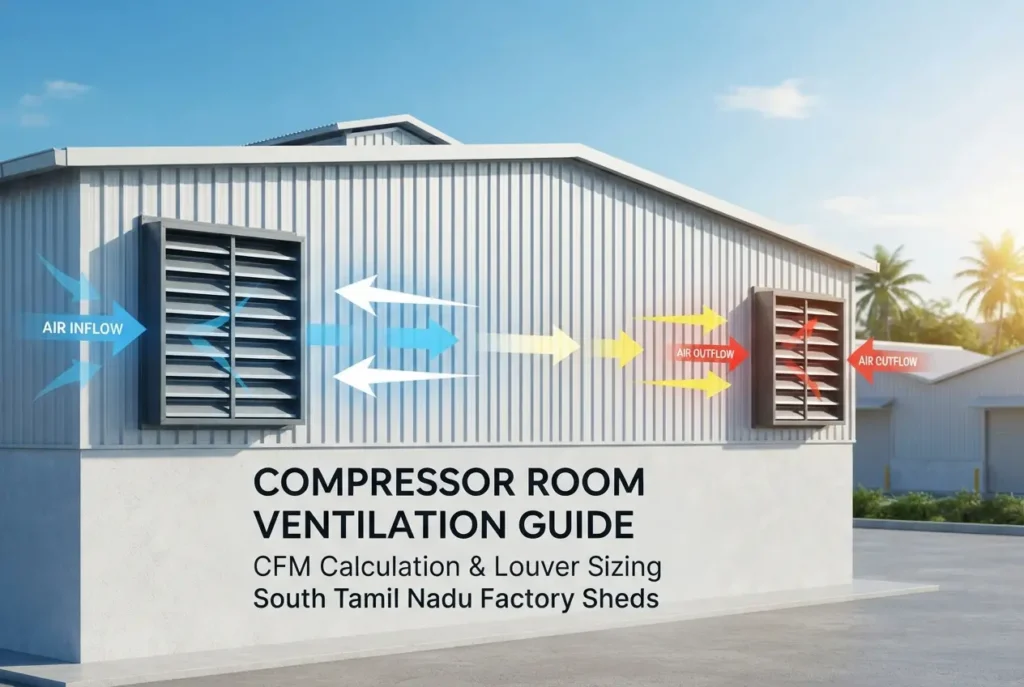
Operating an industrial air compressor in the industrial belts of South Tamil Nadu—from the spinning hubs of Rajapalayam to manufacturing centers across Madurai and Virudhunagar—presents unique environmental challenges. Between March and July, outdoor ambient temperatures frequently exceed 40°C, and metal roofing sheds trap heat, turning poorly planned compressor rooms into thermal traps. When mechanical ventilation is neglected, the heat rejected by the compressor rapidly builds up inside the room, causing the equipment to overheat, trip out on high air-end discharge temperature, and degrade lubricant prematurely.
A standard rotary screw air compressor converts approximately 80 to 90 percent of its electrical input energy into heat. Without a dedicated strategy to extract this continuous thermal load and supply adequate fresh air, ambient room temperatures can quickly reach 50°C or higher. Installing heavy machinery inside an unventilated tin-shed enclosure without proper ventilation is one of the most common reasons why screw compressors struggle during peak summer months.
To avoid costly shutdowns, plant engineers must design their compressor rooms based on thermodynamic principles. This guide breaks down how to calculate the required ventilation air volume (in CFM), size inlet and exhaust louvers properly, and position airflow paths to ensure continuous, reliable operation even during extreme South Indian summers.
The Heat Rejection Reality: Understanding CFM Requirements
Every air compressor generates a massive quantity of heat through air compression and electric motor losses. If this heat stays inside the compressor house, the compressor breathes in its own discharged hot air. The primary goal of compressor room ventilation is twofold: provide combustion/compression air for the airend and introduce enough ambient air to remove the heat radiated by the package.
To calculate the required ventilation airflow in Cubic Feet per Minute (CFM), engineering formulas balance heat rejection against the permissible rise in room temperature:
Ventilation CFM = (Heat Rejected in kW × 3000) / (1.08 × ΔT in °F)
In this formula, ΔT represents the allowable temperature rise of the room above the outdoor ambient temperature. For facilities using air compressors in virudhunagar or Dindigul, keeping ΔT between 5°C and 7°C (approx. 9°F to 12.6°F) is crucial. If ambient summer temperatures already hit 40°C, allowing a large ΔT of 15°C means your intake air will hover at 55°C—well above the typical 45°C maximum ambient rating for standard industrial compressors.
If your room also houses ancillary equipment, such as an air-cooled refrigerated dryer or downstream line filtration systems, their heat rejection must be added to the total cooling load. Overlooking these secondary heat sources is a common oversight that leads plant managers to wonder why screw compressors overheat in south tamil nadu summers and how to fix it.
Sizing Inlet and Exhaust Louvers for Low Velocity
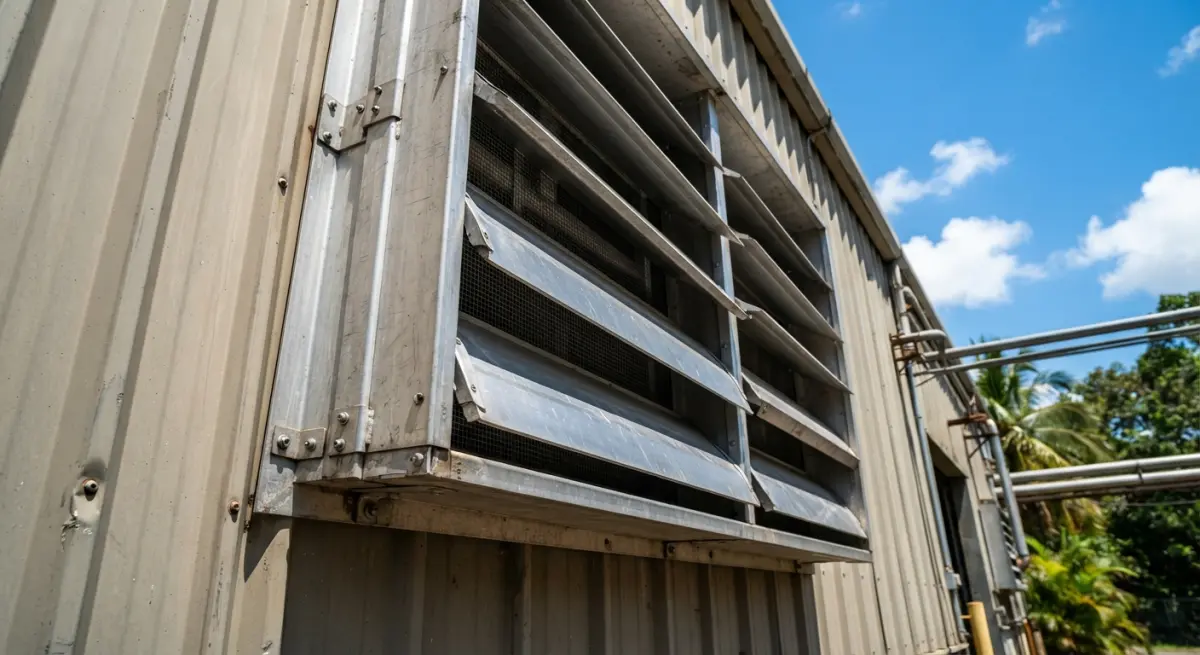
Calculating the required ventilation CFM is only half the battle; getting that volume of air in and out of the room without choking the equipment is the other. Louver sizing dictates the static pressure drop across the room. If louvers are too small, high vacuum levels develop, starving the compressor of air and forcing cooling fans to work against severe backpressure.
When sizing louvers, mechanical engineers use target face velocities:
- Inlet Louvers: Air velocity should not exceed 400 to 500 feet per minute (FPM). Low velocity prevents rain ingress during the Northeast monsoon and reduces the intake of heavy airborne dust and debris.
- Exhaust Louvers (Natural Draft): Velocity should generally stay between 500 and 600 FPM.
- Forced Exhaust (Fan Assisted): Depending on the fan power, face velocities may reach 800 to 1000 FPM, provided the fan can overcome the static resistance of the louver blades.
The gross dimensions of a louver frame are not the same as its free area. Standard fixed weather louvers have a Free Area Ratio between 40% and 55% due to the obstruction of the blades, frame, and bird screens. For example, a 1-meter by 1-meter louver does not provide 1 square meter of airflow; it often provides less than 0.5 square meters. Always divide your calculated net open area by the manufacturer’s free area coefficient (typically 0.45 or 0.50) to determine the actual wall cutout required.
Natural Ventilation vs. Forced Mechanical Exhaust
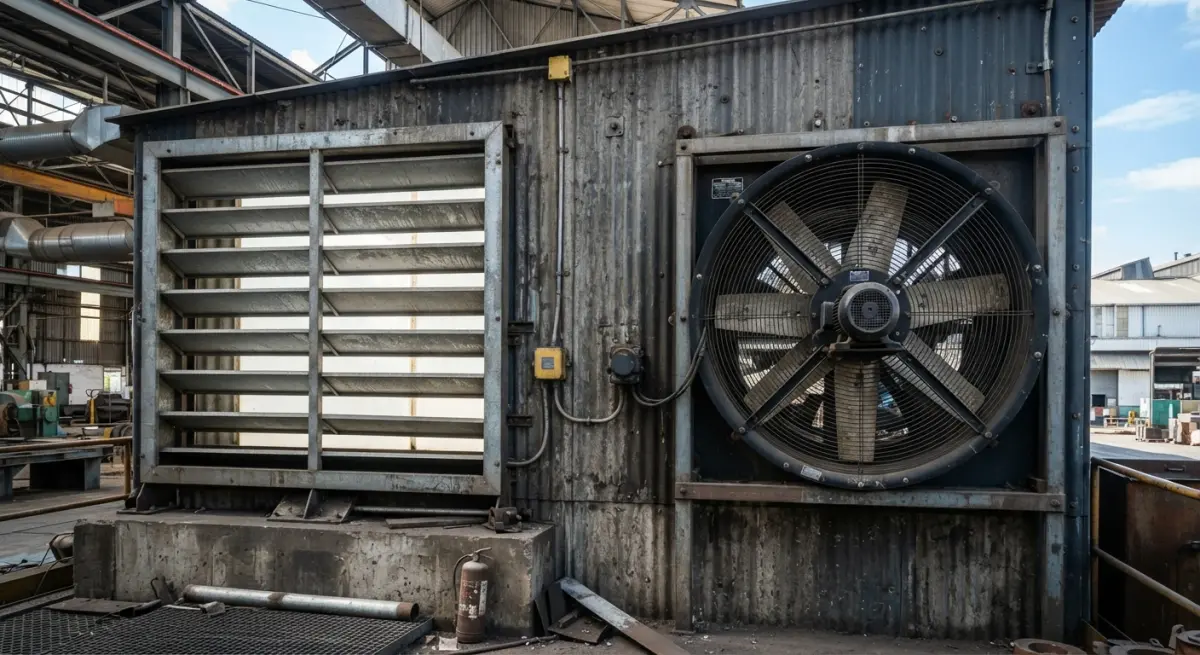
In South Tamil Nadu factory sheds, natural cross-ventilation alone is rarely sufficient for compressor installations above 30 kW. Relying on wind currents or standard roof ridge vents fails on still, windless afternoons when ambient heat builds up rapidly under corrugated metal sheets.
Depending on your budget and physical site layout, two primary approaches exist:
1. Ducting the Compressor Exhaust Directly Outdoors
This is the most efficient configuration. A custom sheet-metal duct is connected to the top exhaust cowl of the compressor cabinet and routed directly through the shed wall or roof. Because the compressor’s internal cooling fan pushes the hot air straight outside, that thermal load never enters the room. Note that long duct runs or tight 90-degree elbows add static pressure, so an auxiliary booster fan may be required if the run exceeds a few meters.
2. Wall-Mounted Heavy-Duty Exhaust Fans
If ducting is not feasible—such as in rooms housing multiple small units or rental machines—wall-mounted propeller or axial exhaust fans must be installed high on the wall opposite the inlet louvers. The total exhaust fan capacity must match or slightly exceed the calculated ventilation CFM plus the air consumption rate of the compressor packages.
Ensuring steady thermal flow also preserves lubrication integrity. Excessive operating temperatures break down synthetic coolants rapidly, accelerating mechanical wear and eventually necessitating costly interventions like rotary screw airend rebuilding vs replacement calculating remaining bearing life and costs.
Layout Best Practices for Factory Sheds
Where you place your inlet and exhaust louvers relative to the prevailing winds and the compressor package is just as critical as sizing them properly. Keep these principles in mind:
- Create a Low-to-High Sweep: Position fresh air intake louvers down low, roughly 0.5 to 1 meter off the finished floor, ideally on the cooler, shaded side of the building (North or East facing). Place exhaust louvers or fans up high on the opposite wall, near the roofline, where rising heat naturally accumulates.
- Prevent Short-Circuiting: Never place the air inlet directly above or beside the hot air discharge. Hot exhaust will simply curl back into the fresh air intake, compounding the thermal build-up inside the room.
- Account for Shed Roof Radiation: Factory sheds built with bare galvalume or asbestos sheets absorb immense solar radiation. The air directly under the roof can be 8°C to 12°C hotter than the air near the floor. Insulating the ceiling or creating a false ceiling inside the compressor room prevents this radiant heat from overwhelming the intake air.
- Consider Local Contaminants: In regional processing plants, such as those found throughout the agricultural and manufacturing clusters around Madurai and Ramanathapuram, airborne lint, husk, or sand can quickly choke fine intake louvers. Ensure louvers are equipped with accessible, washable pre-filter media that operators can clean weekly.
Practical Sizing Example for a 75 kW (100 HP) Screw Compressor
Let us look at a practical scenario common in mid-sized manufacturing plants:
- Compressor Size: 75 kW air-cooled rotary screw compressor.
- Heat Rejection to Room: Approximately 68 kW of heat dissipated through the oil cooler and aftercooler.
- Design Ambient: 40°C outdoor summer temperature.
- Target Room Rise (ΔT): 5°C (9°F rise allowable).
Applying our formula:
Ventilation CFM = (68 × 3000) / (1.08 × 9) = 204,000 / 9.72 ≈ 21,000 CFM
To move 21,000 CFM across an intake louver at a gentle 450 FPM face velocity, the free net area required is:
Net Area = 21,000 CFM / 450 FPM = 46.6 square feet
Assuming a high-efficiency weather louver with a 50% free area rating, the gross wall cutout required is:
Gross Louver Area = 46.6 / 0.50 ≈ 93.2 square feet (for instance, two louvers measuring approximately 7 ft × 6.7 ft each).
If you choose to duct the compressor exhaust directly outdoors, the room ventilation CFM requirement drops substantially—down to roughly 15% to 20% of this figure—because only the radiant motor and package casing heat remains in the space. This simple comparison highlights why exhaust ducting is often the most cost-effective approach for heavy industrial machinery.
Conclusion and Next Steps
Inadequate ventilation is an invisible drain on factory profitability across South Tamil Nadu. It causes unannounced high-temperature trips during mid-day production peaks, shortens the operating life of oil and filters, and forces compressors to consume more energy to deliver the same mass flow of compressed air. Sizing your ventilation CFM and louvers correctly from day one protects your equipment, maintains stable discharge temperatures, and delivers dependable performance year-round.
Whether you are designing a new facility or upgrading an existing shed setup in Madurai, Virudhunagar, or surrounding industrial zones, our application engineering team can assist. Request an air compressor quote or contact our technical team to schedule an on-site compressor room ventilation assessment tailored to your factory’s specific layout.
Frequently Asked Questions
How do I calculate ventilation CFM for an air compressor room in South Tamil Nadu's climate?
To calculate the required CFM, use the heat rejection formula: CFM = (Compressor Motor HP × Heat Rejection Factor × 2545) / (1.08 × ΔT), where heat rejection factor is typically 0.9 for oil-cooled air compressors. In South Tamil Nadu regions like Madurai or Tuticorin, design for a maximum allowable temperature rise (ΔT) of only 5°C to 7°C above the extreme ambient summer peak of 42°C to prevent compressor high-temperature tripping.
What is the recommended air velocity for sizing intake and exhaust louvers in coastal Tamil Nadu industrial sheds?
Air intake louvers should be sized for a face velocity between 400 and 500 feet per minute (FPM) to minimize static pressure drops and prevent airborne dust or light moisture ingestion. For exhaust louvers paired with forced mechanical extraction fans, velocity can be designed between 700 and 900 FPM depending on the fan's external static pressure capability.
How does louver free area percentage impact the wall cutout size in factory compressor rooms?
Standard weather-proof and sand-trap industrial louvers typically offer only 45% to 55% free area, meaning the physical wall opening must be roughly double the calculated aerodynamic airflow area. Failing to divide the required net free area by the manufacturer's free area coefficient will severely choke compressor intake, resulting in high vacuum and motor overheating.
Why is mechanical forced ventilation preferred over natural ventilation for compressor sheds in SIPCOT industrial parks?
South Tamil Nadu experiences prolonged periods of high ambient humidity and low crosswind velocities during hot summer months, rendering natural draft ventilation unreliable for dense industrial heat loads. Forced mechanical ventilation—either via ducted exhaust or wall-mounted axial fans—guarantees continuous air displacement and overcomes static resistance from safety mesh and bird screens.
What louver material and finish are best suited for compressor rooms in the Tuticorin and Manali industrial belts?
Given the harsh combination of coastal salinity and industrial sulfur emissions in zones like Tuticorin, heavy-gauge Marine Grade Aluminum (AA 6063-T6) with minimum 25-micron anodization or factory-applied PVDF coating is essential. Standard galvanized iron (GI) louvers will rapidly corrode, compromising structural integrity and allowing moisture ingress into the electrical compressor drives.
Also read: One Large Compressor or Two Smaller Units? Comparing Backup Capacity and Ownership Cost