In modern textile manufacturing, compressed air serves as an indispensable utility. From spinning mills and air-jet weaving looms to automated yarn winding and garment finishing, pneumatic systems operate around the clock to sustain continuous production. However, textile operations frequently encounter irregular, pulsating air demands. Modern air-jet looms, for instance, release sudden, high-velocity bursts of compressed air to propel weft yarns across the fabric width. When these rapid fluctuations occur across dozens or hundreds of machines simultaneously, the upstream compressor system experiences sharp pressure swings.
Without an adequately sized buffer, this dynamic demand profile leads directly to compressor short-cycling—a condition where the compressor rapidly toggles between loaded and unloaded states. Short-cycling causes significant mechanical wear on intake valves, drive motors, and electrical contactors, while driving up plant power bills through continuous unloaded running. For factory managers evaluating their compressed air network, understanding how to calculate air compressor cfm for your factory alongside receiver capacity is the primary step toward eliminating this issue.
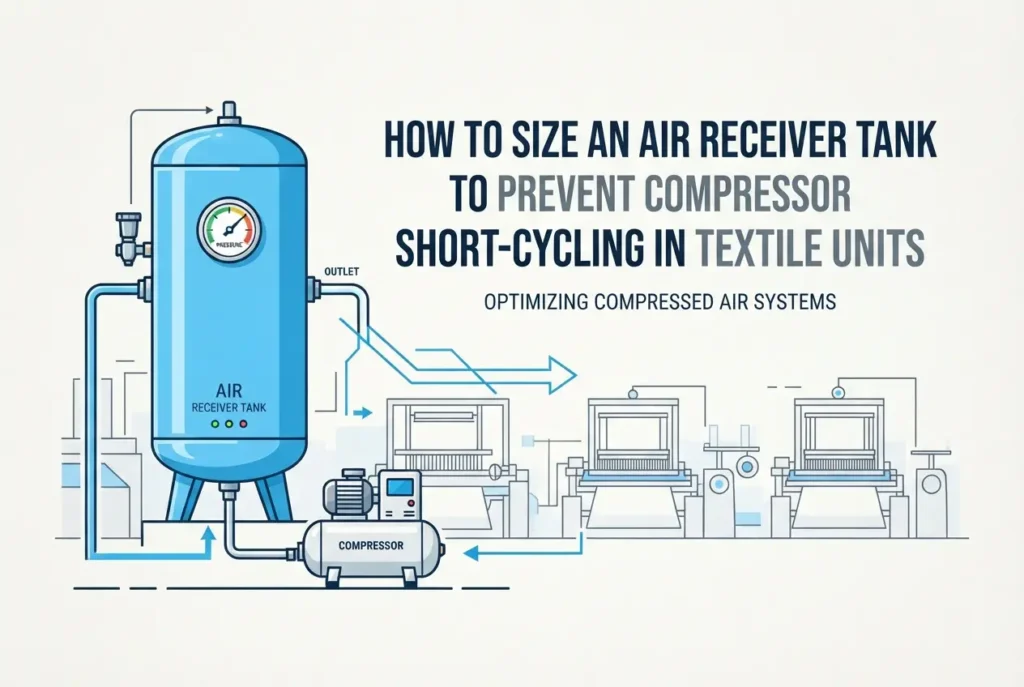
The solution lies in installing a properly engineered air receiver tank. Far more than a passive storage vessel, a well-sized receiver acts as an energy accumulator, a mechanical dampener, and a system stabilizer. Sizing it correctly ensures your textile facility maintains steady line pressure, protects critical weaving machinery, and preserves the lifespan of expensive capital equipment.
Understanding Compressor Short-Cycling in Textile Operations
Short-cycling occurs when the volume of air between the compressor discharge and the point of use is too small to absorb sudden changes in system demand. In an air-jet weaving shed, dozens of loom nozzles may fire simultaneously, causing an instantaneous drop in header pressure. The compressor responds by loading to restore pressure. Moments later, as the cycle shifts and nozzles close, downstream consumption abruptly drops. The line pressure spikes rapidly, prompting the compressor control system to unload.
When this sequence repeats multiple times in a minute, the motor never reaches thermal equilibrium, and mechanical stress accumulates. For fixed-speed rotary screw compressors, repeated loading and unloading wastes enormous amounts of electrical energy, as the motor continues drawing considerable power even while running off-load. While variable frequency drive (VFD) units manage fluctuating demands more efficiently, as discussed in our guide on fixedspeed vs vfd air compressor which is right for your factory, an undersized receiver will still force a VFD to hunt aggressively, degrading process stability.
The Essential Roles of an Air Receiver Tank
An air receiver tank performs three core functions that directly prevent short-cycling across spinning and weaving floors:
- Demand Buffering: The tank stores a reservoir of pressurized air that instantly supplies peak, intermittent demands without forcing the compressor to load immediately.
- Control Damping: By increasing the total capacitance of the distribution piping, the receiver slows down the rate of pressure change, allowing compressor control loops sufficient time to react smoothly.
- Moisture Separation: As hot compressed air enters the expanded volume of the receiver, the air velocity slows down and cools slightly. This prompts bulk moisture and oil aerosols to condense and settle at the bottom drain, protecting downstream filters and reducing the load on your refrigerated air dryers.
The Engineering Method: How to Size Your Air Receiver
Sizing an air receiver for a textile unit requires more than a generic rule of thumb. It requires balancing the peak flow differential, the allowable pressure drop across the weaving line, and the desired cycle time of the compressor.
To determine the minimum receiver volume needed to handle intermittent demand events, engineers utilize the following fundamental formula:
V = (t × ΔQ × P_a) / ΔP
Where:
- V: Required receiver volume in cubic feet (or liters)
- t: The time duration (in minutes) that the peak event lasts or the minimum desired load cycle duration
- ΔQ: The peak demand volume that exceeds the continuous compressor output (in CFM or m³/min)
- P_a: Atmospheric pressure at your plant location (typically standard atmospheric pressure at sea level, adjusted for elevation)
- ΔP: Allowable pressure band (the difference between the cut-out and cut-in pressure setpoints, or the allowable pressure drop during peak firing)
In textile facilities, the allowable pressure band (ΔP) is often tight because air-jet looms demand tightly regulated pressure to ensure consistent yarn insertion and prevent fabric defects. A narrower allowable pressure drop requires a proportionally larger receiver tank to supply the same volume of air without dropping below critical loom thresholds.
Wet vs. Dry Storage Configuration in Textile Mills
Where you place the receiver tank in your compressed air room is just as crucial as its internal capacity. Textile mills benefit immensely from a dual-receiver approach: placing one “wet” receiver before the air treatment chain and one “dry” receiver after it.
A wet receiver sits directly between the compressor discharge and the drying equipment. It captures large slugs of liquid condensate, dampens mechanical pulsations from reciprocating boosters, and cools the air before it reaches pre-filters. Following this stage, learning why factories need a refrigerated air dryer illustrates how removing remaining water vapor prevents rust inside distribution pipes and stops water droplets from staining raw fabrics.
A dry receiver is positioned immediately downstream of the refrigerated dryer and high-efficiency filters. This tank stores clean, dry, treated air directly upstream of the main distribution headers. When the weaving shed creates a sudden demand spike, air is drawn directly from the dry tank. This prevents high air velocity from rushing through the dryer and desiccant beds, which would otherwise overwhelm moisture separators and carry contaminants straight into the loom solenoids.
Practical Tips for Stable Air Receiver Performance
To ensure your air receiver installation protects your machinery and minimizes energy waste over its operational life, implement these field-proven practices:
- Account for Header Pipe Volume: High-efficiency ring-main distribution networks contribute to total air capacitance. Evaluating aluminum vs gi piping for industrial compressed air pressure drop and lifetime cost comparison can help you design low-friction piping networks that complement your receiver sizing.
- Install Zero-Loss Auto Drains: Receiver tanks continuously accumulate condensate. Timed solenoid valves often fail open or stick closed; zero-loss electronic level-sensing drains discharge water automatically without venting valuable compressed air.
- Avoid Narrow Pressure Bands: Setting your compressor’s cut-in and cut-out points too close together (such as a gap narrower than half a bar) forces frequent cycling regardless of tank size. Maintain a reasonable control differential to give the receiver headroom to work.
- Distribute Point-of-Use Tanks: For extensive textile plants with distant weaving or texturizing halls, install localized auxiliary receiver tanks directly adjacent to high-draw machinery. This stabilizes pressure locally without requiring an oversized central receiver.
Conclusion
Preventing compressor short-cycling in textile environments is not simply a matter of purchasing the largest compressor available. Rather, it requires engineering a balanced system where supply capacity, dynamic storage, and distribution efficiency work together. By correctly calculating receiver volume based on loom burst profiles and allowable pressure drops, textile plant operators can eliminate erratic cycling, lower monthly power bills, and guarantee uninterrupted fabric production.
Are you looking to optimize air pressure stability across your textile machinery or upgrade your compressed air infrastructure? Explore our comprehensive range of air compressors 038 compressedair products, or reach out to our engineering team directly to request an air compressor quote tailored to your plant’s exact operating parameters.
Frequently Asked Questions
What is the standard formula for sizing an air receiver tank in a textile mill to prevent short-cycling?
The standard sizing formula is V = (t × C × Pa) / (P1 – P2), where V is receiver volume, t is the allowable cycle time, C is the peak dynamic flow requirement, Pa is atmospheric pressure, and (P1 – P2) represents the allowable pressure drop. For textile mills, sizing the tank to provide 3 to 5 gallons per CFM of compressor output generally provides the required buffer to smooth out rapid load changes. This prevents the compressor from repeatedly loading and unloading within short time frames.
How do air-jet weaving looms cause compressor short-cycling if the receiver tank is undersized?
Air-jet looms consume compressed air in rapid, high-volume cyclic pulses during weft insertion, causing severe momentary pressure drops in the distribution network. When the receiver tank lacks the capacity to absorb these instantaneous spikes, the localized line pressure fluctuates rapidly past the compressor's cut-in and cut-out thresholds. This dynamic causes the compressor to rapidly cycle between load and unload states, leading to mechanical wear and energy inefficiency.
What is the ideal pressure differential (deadband) setting to stop compressor rapid cycling in textile units?
A recommended pressure differential (deadband) for rotary screw compressors in textile applications is typically between 10 to 15 PSI (0.7 to 1.0 bar) across the control range. Setting the deadband narrower than 10 PSI frequently causes rapid cycling during burst demands, while setting it too wide unnecessarily elevates operating pressure and energy consumption. An adequately sized receiver tank allows the system to remain within this optimal 10-15 PSI band without triggering premature compressor state changes.
Should textile mills install wet or dry air receiver tanks to protect compressors from short-cycling?
Textile units benefit most from installing a combination of both wet and dry storage, but a wet tank directly prevents short-cycling by acting as an immediate dynamic buffer right after the compressor. The wet tank absorbs the compressor's discharge pulsations and dampens feedback from rapid factory demand before the air reaches downstream treatment equipment. A dry tank downstream from the desiccant or refrigerated dryer then provides an additional moisture-free reserve to stabilize sensitive air-jet looms and spinning frames.
What mechanical problems occur in textile plant air compressors due to persistent short-cycling?
Persistent short-cycling causes premature failure of the compressor's intake inlet valve and blowdown solenoid mechanisms due to excessive mechanical actuation. It also subjects drive motors to frequent current inrushes and thermal stress, dramatically shortening insulation life and driving up electrical utility costs. Furthermore, rapid cycling degrades compressor lubricants and leads to oil carryover into downstream filtration, which risks staining or contaminating delicate textile fabrics.
Also read: Why Screw Compressors Overheat in South Tamil Nadu Summers (And How to Fix It)