
Moisture is one of the most stubborn and destructive contaminants in any industrial compressed air system. When ambient air enters a compressor, it brings ambient humidity along with it. As that air is squeezed into a smaller volume, its ability to hold moisture changes dramatically, leading to liquid condensation inside your headers, valves, and pneumatic tools. To control this problem, engineers and facility managers rely on a metric known as dew point.
However, confusion often arises when reviewing technical datasheets or discussing drying equipment: are you measuring Atmospheric Dew Point (ADP) or Pressure Dew Point (PDP)? While the names sound interchangeable, confusing the two can lead to catastrophic miscalculations. You might believe your compressed air is bone-dry when it is actually on the verge of flooding your production line with water.
Understanding the distinction between atmospheric dew point and pressure dew point is fundamental to designing a reliable air treatment system. In this guide, we will break down what these terms mean, explore the physics that separates them, and look at how targeting the right dew point protects your machinery and final product quality.
What Is Dew Point in Compressed Air?
At its simplest, dew point is the temperature to which air must be cooled for water vapor to condense into liquid water (dew). Warm air has a higher capacity to retain water vapor than cold air. When air cools down, it eventually reaches 100 percent relative humidity—the saturation point. Any drop in temperature past this saturation threshold forces water vapor out of the gas phase and into liquid droplets.
In compressed air systems, maintaining an appropriate dew point ensures that liquid water never forms inside your distribution lines. Liquid moisture causes internal pipe rust, washes away lubricating grease in pneumatic cylinders, ruins paint finishes, and can contaminate sensitive products like food or electronics. To meet stringent international criteria, such as the compressed air iso 85731 quality standards for food processing and packaging plants, precise dew point control is non-negotiable.
Atmospheric Dew Point vs. Pressure Dew Point: The Core Difference
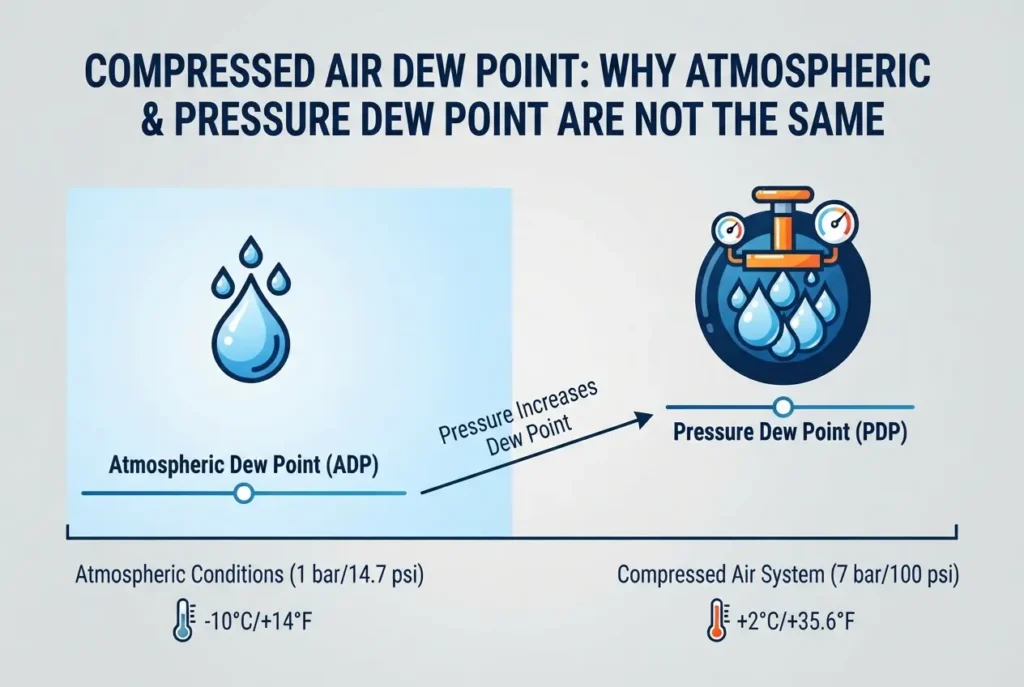
The difference between Atmospheric Dew Point (ADP) and Pressure Dew Point (PDP) comes down to a single variable: operating pressure.
Atmospheric Dew Point (ADP) is the temperature at which water vapor will condense out of air under standard ambient atmospheric pressure (roughly 1 bar absolute or 0 psig). This is the dew point value you hear during daily weather forecasts or encounter when measuring open-air ambient conditions.
Pressure Dew Point (PDP), on the other hand, is the temperature at which water vapor will condense out of air at an elevated pressure—the actual operating pressure inside your compressed air piping (typically 7 bar / 100 psig or higher). Because compressing air forces water molecules closer together, compressed air reaches its saturation point at a significantly higher temperature than air at atmospheric pressure.
To put this in perspective: if you compress air to 7 bar, its pressure dew point is vastly higher than its atmospheric dew point. Air with an atmospheric dew point well below freezing can still produce gallons of liquid water if it is kept under pressure at ambient plant temperatures. In industrial environments, PDP is the only metric that reflects what is actually happening inside your live air lines.
The Physics: Why Pressure Changes the Condensation Point
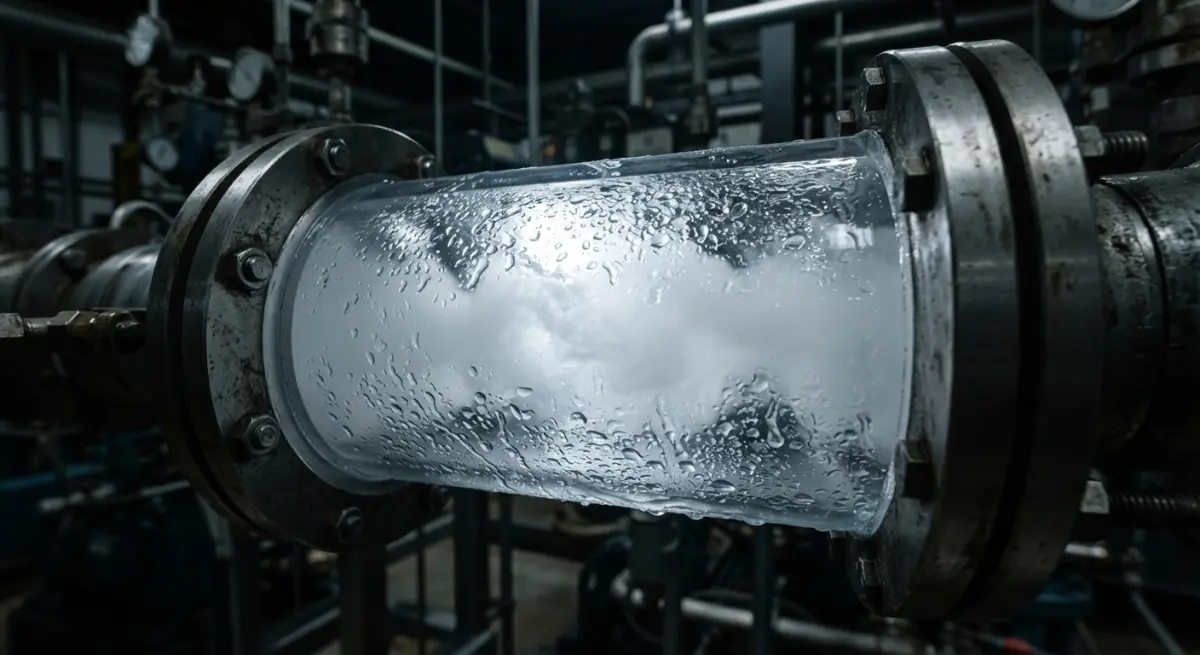
The relationship between pressure, volume, and moisture capacity is governed by Dalton’s Law of Partial Pressures. When an air compressor pulls in ambient air and reduces its volume, the partial pressure of the water vapor increases in proportion to the compression ratio.
Consider an intake stroke pulling in eight cubic meters of ambient air at atmospheric pressure. The compressor squeezes this volume down into a single cubic meter at approximately 7 bar gauge pressure. While the volume of air has decreased by a factor of eight, the total amount of water vapor trapped inside remains the same initially. As a result, the moisture concentration per unit volume skyrockets.
Because the air is now holding several times more moisture per cubic meter than it normally would, its capacity to hold that water vapor without condensing is drastically reduced. Therefore, the air does not need to be cooled very much before it becomes completely saturated. This is why the pressure dew point is always significantly higher than the atmospheric dew point for the same quantity of moisture.
If you take air that has been dried under pressure and vent it into the atmosphere, the pressure drops instantly. As the air expands, its moisture concentration disperses over a much larger volume, causing its relative humidity to plunge. The resulting atmospheric dew point of that expanded air will read much colder than the pressure dew point was when the air was confined inside the pipe.
Why Mixing Up ADP and PDP Leads to Expensive Mistakes
Misinforming or misunderstanding dew point specifications can cause significant operational headaches. Here is why mixing them up is dangerous:
- Undersized Drying Equipment: Desiccant and refrigerated air dryers are rated based on Pressure Dew Point. If an equipment buyer mistakenly specifies an atmospheric dew point of 3°C instead of a pressure dew point of 3°C, they may end up with a dryer that cannot handle the actual moisture load under pressure. Understanding why factories need a refrigerated air dryer starts with knowing your real PDP requirements.
- Corrosion and Contamination: Believing your air is safe because a sensor read an atmospheric equivalent can leave your distribution headers vulnerable. Liquid moisture will accumulate inside lines, leading to corrosion, pressure drops, and scale formation that ruins tools downstream.
- False Confidence in Outdoor Lines: If your plant runs piping outdoors between buildings, ambient nighttime temperatures can easily drop below the compressed air’s pressure dew point. If the PDP is not lower than the lowest ambient temperature your pipes encounter, water will condense inside those outdoor lines and potentially freeze, creating blockages.
Practical Tips for Managing Pressure Dew Point
Keeping your system dry and reliable requires active measurement and thoughtful air treatment strategies. Keep these practical considerations in mind:
- Always Specify PDP in Equipment Quotes: Whenever you request quotes for dryers, filtration units, or turnkey compressor rooms, always insist that dew point targets are stated as Pressure Dew Point at your specific operating pressure (e.g., “+3°C PDP at 7 bar g”).
- Match the Dryer to the Application: A standard refrigerated dryer typically delivers a pressure dew point around +3°C to +7°C, which is ideal for indoor manufacturing. However, if your compressed air runs through sub-zero environments, or if you produce pharmaceuticals or sensitive electronics, you will need a desiccant dryer capable of delivering a PDP of -20°C or -40°C.
- Incorporate Multi-Stage Filtration: Dryers work best when protected from bulk liquids and lubricants. Combining high-efficiency separators with appropriate line filters ensures that your air dryer operates at peak efficiency without fouling. Understanding coalescing vs particulate downstream line filters selection and replacement intervals explained is essential for protecting downstream desiccant beds and heat exchangers.
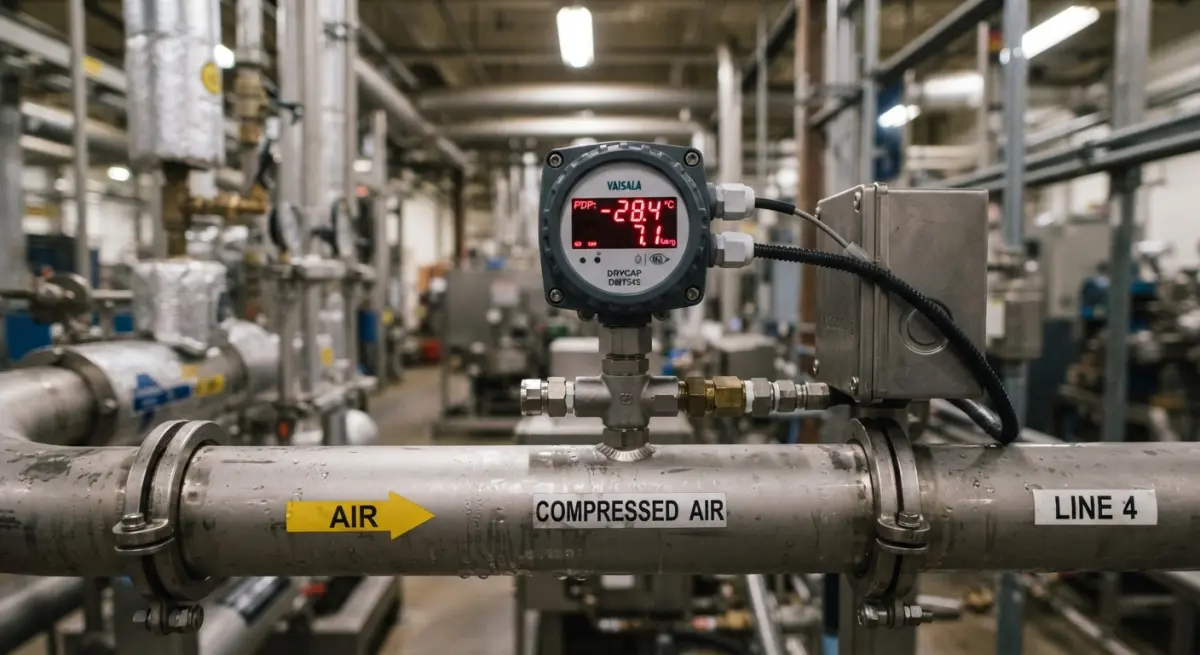
- Sample Air at Full Operating Pressure: If you use portable dew point meters or install inline hygrometers for quality monitoring, ensure the sensor cell is measuring the air sample at system pressure or uses an internal algorithm that accurately calculates PDP based on a pressure sensor input.
Keep Your Compressed Air Clean and Dry
In the world of compressed air, precision matters. Treating Atmospheric Dew Point and Pressure Dew Point as the same thing is a costly oversight that risks tool failure, system corrosion, and contaminated end products. By remembering that pressure elevates the condensation point—and always designing your treatment system around Pressure Dew Point—you can protect your facility from hidden moisture issues.
If you are planning an upgrade or want to evaluate your plant’s air treatment design, our engineering team can help. Request an air compressor quote today to get expert sizing guidance on dryers, filtration systems, and complete compressed air packages tailored to your specific application.
Frequently Asked Questions
What is the main difference between Pressure Dew Point (PDP) and Atmospheric Dew Point (ADP)?
Pressure Dew Point (PDP) is the temperature at which water vapor condenses into liquid inside a pressurized air system, while Atmospheric Dew Point (ADP) is the condensation temperature after that air expands to ambient pressure. Because compression forces water molecules closer together, PDP is always significantly higher than ADP for the same volume of air. Using ADP to evaluate a pressurized system will lead to false assumptions about moisture levels, risking severe downstream condensation.
Why does dew point change when compressed air pressure changes?
Dew point is directly tied to water vapor saturation, which depends heavily on pressure. When air is compressed, its volume decreases, forcing moisture molecules into tighter spaces and raising the partial vapor pressure, which causes condensation to occur at a higher temperature. Conversely, when compressed air expands back to ambient atmospheric pressure, the vapor pressure drops, lowering the temperature required for saturation to occur.
How do you accurately convert between Atmospheric Dew Point and Pressure Dew Point?
You can convert between the two values using specialized conversion charts, online calculators, or standard thermodynamic formulas based on Dalton's and Antoine's laws. The calculation requires your baseline dew point temperature along with the exact operating gauge pressure of the compressed air system. Never use simple linear math for this conversion, as the relationship between saturation vapor pressure and temperature is logarithmic.
Why is measuring Pressure Dew Point critical for compressed air dryers?
Compressed air dryers operate on air at line pressure, meaning the moisture load and condensation risk exist under that specific pressure condition. Measuring Pressure Dew Point (PDP) ensures the dryer meets ISO 8573-1 air quality standards and prevents liquid water from damaging pneumatic tools, valves, and end products. If you measure atmospheric dew point instead, you risk under-drying the air, leading to hidden corrosion and microbial growth inside your piping.
Can I use an ambient dew point sensor to monitor my compressed air system?
No, an ambient dew point sensor cannot withstand system pressure and will yield misleading data if exposed directly to the compressed air stream. To monitor compressed air accurately, you must use a dedicated Pressure Dew Point sensor installed directly into the pipe or within a depressurized sample cell designed for controlled expansion. Standard ambient sensors will only measure Atmospheric Dew Point, which dramatically underestimates the condensation risk inside your pressurized lines.
Also read: Why Operating Above 7 Bar Wastes Power: Sizing Header Pressure to Match Tool Requirements