
In any industrial facility, generating compressed air is only half the battle. Once ambient air is drawn in, compressed, and discharged into the header pipe, it carries an undesirable mixture of atmospheric dust, ambient humidity, degraded compressor lubricants, and rust particles stripped from the distribution network. Without proper treatment, this contaminated stream moves straight toward sensitive pneumatic cylinders, control valves, paint booths, and packaging equipment, causing premature tool failure, product contamination, and costly operational downtime.
Downstream filtration serves as the critical defense system for your pneumatic infrastructure. However, maintenance teams often struggle to balance the roles of different filter types within the treatment train. Two of the most essential components in clean air delivery are coalescing filters and particulate filters. While they appear identical from the outside—both typically housed in cylindrical aluminum or steel bowls—their internal physics, target contaminants, and placement requirements are fundamentally different.
Understanding the distinction between coalescing and particulate downstream line filters is critical for maintaining plant reliability and energy efficiency. Selecting the wrong filter for a specific contaminant load or failing to replace spent filter elements on schedule can lead to significant line pressure drops, spiked compressor energy costs, and poor air quality at the point of use. Here is what you need to know about how these filters function, how to size and position them, and how to establish a reliable replacement interval.
Understanding the Working Principles: Coalescing vs. Particulate
To choose the correct filtration setup, it helps to understand the physical mechanics occurring within each filter housing.
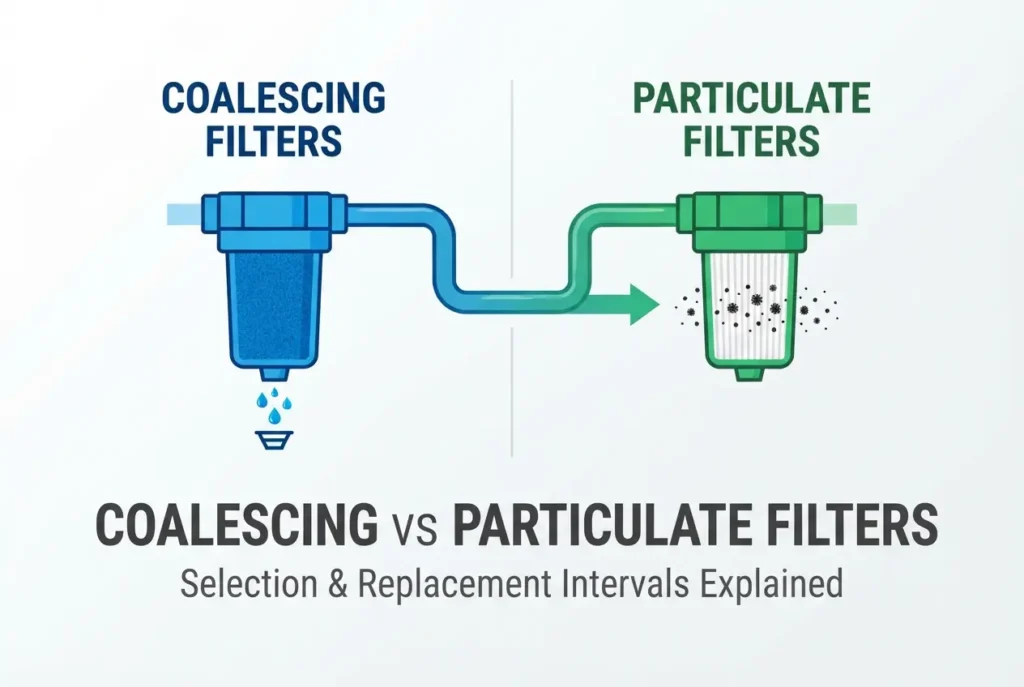
Particulate filters, often referred to as general-purpose pre-filters or dry-dust filters, work by direct interception, inertial impaction, and diffusion. As compressed air passes through a porous, pleated media—commonly constructed from cellulose, polyester, or sintered bronze—solid particles larger than the filter pore size are captured on the media surface or within its depth. Particulate filters are designed primarily to eliminate dry, solid contaminants such as scale, rust, pipeline debris, and ambient dirt. They flow from the outside of the element inward, capturing dirt particles in the outer layers while clean air exits through the center core.
Coalescing filters, on the other hand, are engineered to tackle liquids and sub-micron aerosols that pass directly through standard particulate filters. They capture oil mists and moisture vapors suspended in the air stream. Inside a coalescing element, air generally flows from the inside of the cartridge outward. Fine glass microfibers intercept microscopic liquid droplets. As these minuscule droplets strike the fibers, they merge (coalesce) into larger droplets. Gravity pulls these larger, heavier liquid beads down through an outer drainage layer—typically an open-cell foam sock—into the quiet zone of the filter bowl, where an automatic drain valve expels them from the system.
While a high-efficiency coalescing filter can also capture fine solid particles, doing so degrades its ability to drain liquid oil and water. Solid debris embeds permanently into the dense microglass matrix, blinding the drainage pathways and causing sharp, permanent pressure drops.
Strategic Placement in the Compressed Air Train
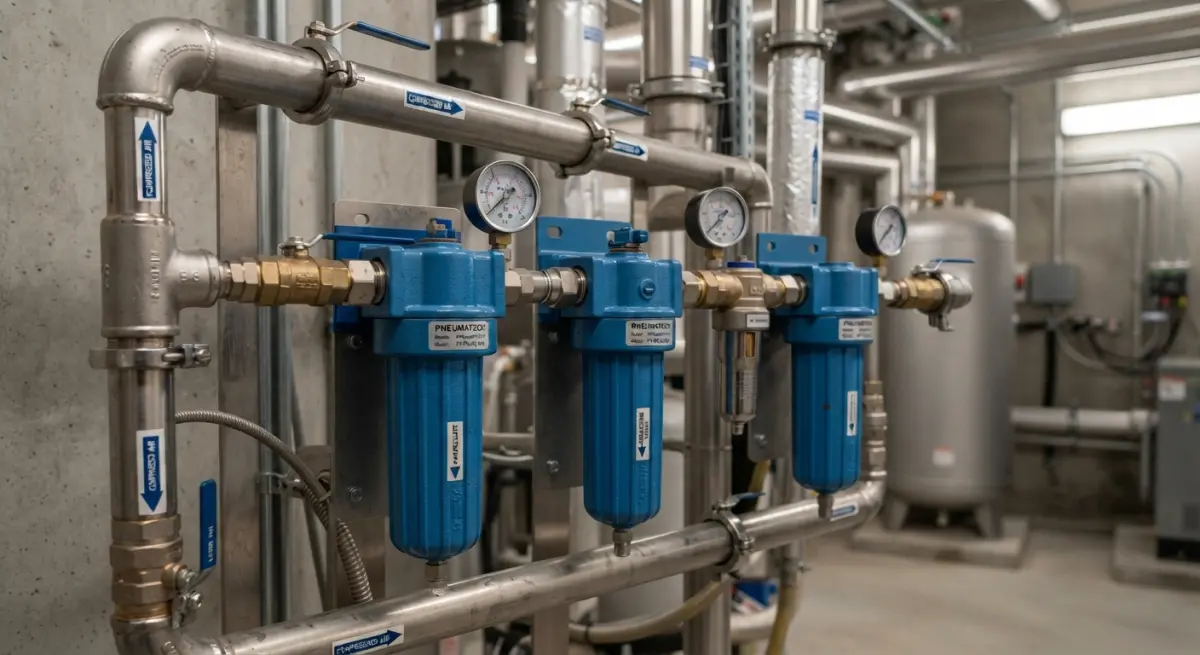
A common error in air line design is treating filters as standalone solutions rather than as parts of an integrated cascade. Placing a fine coalescing filter directly downstream of an air compressor without a pre-filter will choke the element with pipe rust and ambient dirt within weeks.
For high-precision applications—such as cleanrooms, food processing, or automotive paint finishing—compliance with stringent standards like compressed air iso 85731 quality standards for food processing and packaging plants demands a staged approach. A proper filtration train follows a logical progression:
- Stage 1: Bulk Water and Coarse Particulate Separation: Directly following the aftercooler and wet receiver tank, a bulk liquid separator or coarse particulate filter removes the bulk condensate and larger solid rust particles (typically down to 3 to 5 microns).
- Stage 2: General Purpose Coalescing / Pre-Dryer Filtration: Before the compressed air enters a desiccant or refrigerated dryer, a general coalescing filter removes liquid water and coarse oil aerosols down to 1 micron. Protecting the dryer is vital; this is precisely why factories need a refrigerated air dryer operating at peak heat-transfer efficiency without an insulating coat of compressor oil lining its heat exchanger tubes.
- Stage 3: High-Efficiency Oil Removal: Post-dryer, a fine coalescing filter polishes the air by capturing sub-micron oil aerosols down to 0.01 microns, safeguarding precision instrumentation.
- Stage 4: Post-Desiccant Particulate Filtration: If a desiccant dryer is utilized, desiccant beads naturally abrade over time, creating fine, abrasive desiccant dust. A dedicated dry particulate filter must be installed immediately downstream of the dryer towers to prevent this abrasive powder from scoring valve seals and pneumatic actuators.
If you are re-evaluating your distribution network, note that line contaminants are also influenced by piping material. For instance, evaluating aluminum vs gi piping for industrial compressed air pressure drop and lifetime cost comparison can reveal whether internal pipe corrosion is prematurely overloading your downstream particulate filters.
Determining the Right Filter Replacement Intervals

One of the most frequent questions facility managers ask is: When should we change the filter elements?
Operating a filter element past its usable lifespan leads to two major failure modes: element rupture and excessive differential pressure. If a filter ruptures, all trapped contaminants are dumped instantaneously downstream into your production tools. If the element remains intact but heavily clogged, your compressor must run at higher discharge pressures to overcome the resistance across the filter, driving your utility bills through the roof.
Relying on guesswork or arbitrary schedules is inefficient. Filter replacement should be dictated by two key metrics: operating hours and differential pressure.
1. Differential Pressure (Delta P)
Modern industrial line filters are fitted with differential pressure gauges or pop-up indicators. When an element is brand new and dry, it will exhibit a minimal initial pressure drop. As the filter captures dirt and oil, flow resistance increases. As a rule of thumb, when the differential pressure across the housing reaches between 5 to 7 psi (or enters the red zone on a differential gauge), the element has reached the end of its economic life and must be changed.
2. Maximum Calendar and Operating Time
Even if the differential pressure gauge looks acceptable, coalescing filter media degrades over time due to constant exposure to synthetic compressor oils, acidic condensates, and thermal cycling. The microglass matrix can weaken and develop micro-tears that allow oil to pass through without registering a high differential pressure. Consequently, line filters should generally be replaced after one year (or 8,000 running hours) of service, whichever comes first, regardless of the differential pressure reading.
Practical Tips for Maintaining Downstream Line Filters
To extract the best performance from your compressed air filtration system and protect your investment, implement these practical best practices:
- Never Bypass Auto-Drains: Coalescing filters rely completely on effective drainage. If the automatic drain fails or is shut off, the coalesced oil and water will back up into the bowl until the liquid reaches the bottom of the filter element. When that happens, the air stream picks up the liquid again in large slugs, defeating the entire purpose of the filter. Periodically test and clean drain valves.
- Size for Flow, Not Pipe Diameter: Always select filter housings based on the maximum anticipated volumetric flow rate (CFM or m³/min) and minimum operating pressure, not by matching the existing pipe connection size. Oversizing a filter element slightly lowers initial differential pressure, extends element life, and reduces energy consumption.
- Monitor Seasonal Temperature Changes: Elevated ambient temperatures lower air density and increase compressor discharge temperatures, driving more moisture and vaporized oil through the lines. During hot months, inspect downstream filter auto-drains more frequently to ensure they manage the higher liquid loads effectively.
- Do Not Attempt to Wash Microglass Elements: While some coarse mesh mechanical strainers can be cleaned, particulate and coalescing elements made from pleated paper, cellulose, or borosilicate glass fibers cannot be washed with solvents or blown out with blowguns. Doing so destroys the fiber orientation and compromises filtration integrity. Always replace with new elements.
Achieve Reliable, High-Purity Compressed Air
Clean, dry compressed air is not an accident—it is the direct outcome of choosing the right filtration technology and committing to proactive maintenance. By pairing durable particulate pre-filters to capture solid pipeline grit with precision coalescing filters to strip away liquid aerosols, you protect downstream machinery, minimize unbudgeted shutdowns, and keep energy expenditures in check.
If you are experiencing unexpected pressure drops, oil carryover, or frequent filter fouling across your manufacturing facility, our engineering team can assess your air generation and distribution system. Contact sk air solutions today to evaluate your air quality and optimize your downstream filtration train for reliable, long-term performance.
Frequently Asked Questions
What is the main difference between coalescing and particulate downstream line filters?
Particulate filters remove solid contaminants like rust, scale, and pipe dust through mechanical sieving down to a specific micron size. In contrast, coalescing filters merge microscopic liquid aerosol droplets, such as oil and water vapor, into larger drops to drain them away. Installing them together creates a multi-stage defense, with particulate filters protecting coalescing elements from clogging prematurely.
Should a particulate or coalescing filter be installed first in a compressed air line?
A particulate filter should always be installed upstream, directly before the coalescing filter. Coalescing media is highly sensitive and can quickly blind if exposed to heavy solid debris like metal scale or desiccant dust. Placing the particulate pre-filter first captures large solids, extending the operational life and efficiency of the more expensive coalescing element.
How often should you replace coalescing downstream line filter elements?
Coalescing elements should typically be replaced every 6 to 12 months, or sooner if the pressure differential gauge indicates an unacceptable drop across the housing. While they drain liquids continuously, non-draining fine particulates become trapped in the matrix, permanently increasing restriction. Waiting too long increases compressor energy costs significantly and risks contaminated air bypassing the saturated filter media.
What differential pressure indicates it is time to replace a particulate downstream filter?
Most manufacturers recommend replacing particulate filter elements when the differential pressure reaches 8 to 10 psi (0.5 to 0.7 bar), or annually during routine maintenance. An elevated pressure drop indicates the filter pores are completely saturated with solid contaminants, reducing downstream airflow. Running filters beyond this threshold forces the air compressor to work harder, leading to higher electrical costs.
Can a coalescing filter remove water vapor from a compressed air system?
No, coalescing filters only remove liquid water droplets and oil aerosols, not moisture in the vapor or gaseous phase. To eliminate water vapor and lower the system's pressure dew point, you must use a refrigerated or desiccant air dryer. However, a coalescing filter is vital to install upstream of desiccant dryers to prevent compressor oil from fouling the drying media.