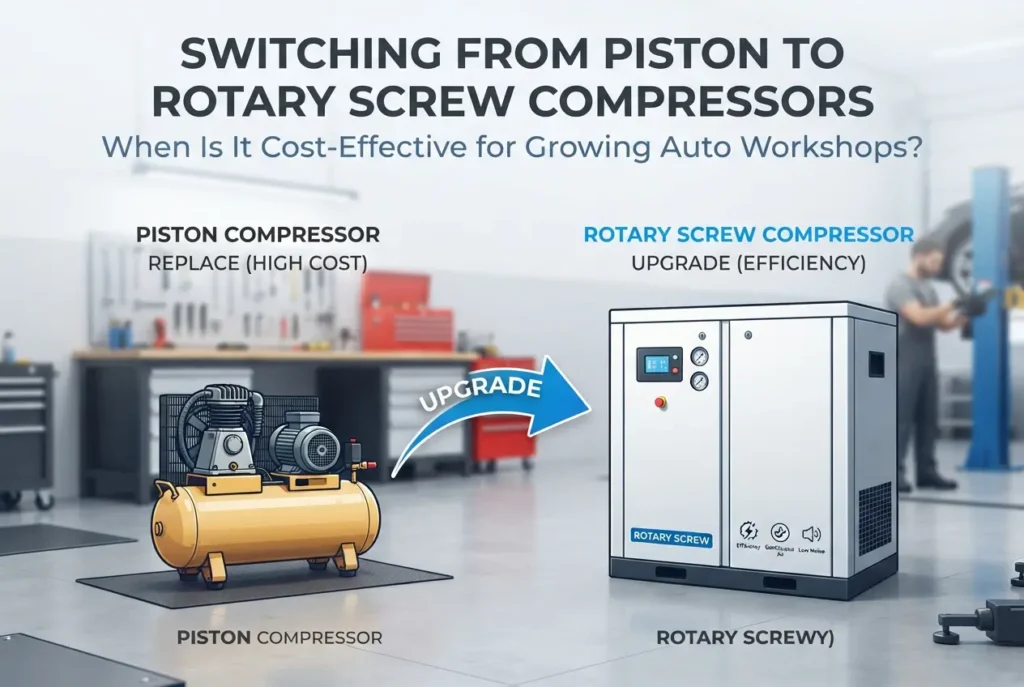
Every growing auto repair and body workshop eventually hits a operational bottleneck where air tools feel sluggish, painting equipment suffers from fluctuating line pressure, and the workshop floor is filled with the relentless hammering of a reciprocating piston compressor. For a small two-bay garage handling routine tire changes and occasional suspension work, a traditional piston compressor does the job. It is affordable to buy, mechanically simple, and capable of delivering bursts of high-pressure air.
However, as your service volume expands, the demands on your compressed air network change drastically. Multiple technicians drawing air simultaneously for pneumatic impact wrenches, air sanders, vehicle lifts, and spray guns quickly push a piston compressor beyond its intended operating limits. When you find your compressor running continuously, throwing hot air downstream, and driving up your energy bills, the question shifts from whether you need an upgrade to whether upgrading to a rotary screw compressor makes financial and operational sense.
Making the leap from a reciprocating unit to a rotary screw system represents a noticeable upfront investment. Determining the exact crossover point where this switch becomes genuinely cost-effective requires examining your duty cycle, air demand profiles, energy consumption patterns, and maintenance overhead.
Duty Cycle Differences: Intermittent Bursts vs. 100% Continuous Output
The primary engineering distinction between reciprocating piston units and rotary screw compressors lies in their duty cycle ratings. Piston compressors are inherently designed for intermittent operation. Their reciprocating internal components generate intense friction and heat within the cylinder heads. To avoid rapid wear, overheating, and oil breakdown, a standard industrial piston unit generally requires substantial resting time between pumping cycles.
When an expanding workshop forces a piston unit to operate continuously, the machine quickly runs outside its engineered thermal envelope. The lubricating oil overheats and thins, increasing friction across the rings and cylinder walls. The compressor begins passing significant amounts of vaporized oil downstream into your air distribution lines, ruining air tools and contaminating spray finishes.
In contrast, rotary screw compressors utilize two intermeshing helical rotors that compress air smoothly and continuously. They are designed for a 100% continuous duty cycle. In fact, screw compressors run most efficiently when they are working continuously under steady load, maintaining an optimal operating temperature that naturally boils off ambient moisture within the internal oil circuit. If your workshop regularly pushes its existing equipment past safe run-time limits, transitioning to a screw unit eliminates premature wear and equipment shutdowns.
Evaluating Your Air Volume and Shop CFM Demand
Before considering a hardware switch, you need an accurate picture of your actual air consumption across peak operating hours. Pneumatic equipment in automotive service varies dramatically in volume demand. While an impact wrench operates in quick five-second bursts, equipment like continuous DA sanders, media blasters, and pneumatic paint guns demand continuous, high-volume air delivery.
Understanding how to calculate air compressor cfm for your factory or workshop environment allows you to determine whether multiple technicians are starving each other’s tools of required volume. If you run three technicians sanding body panels at the same time, their combined continuous air draw will outstrip almost any single reciprocating workshop unit, leading to drops in line pressure that halt productivity.
When your calculated steady-state demand reaches the point where a piston unit must run non-stop to keep up, a rotary screw system delivers the stable volume necessary to run tools at their rated power without causing line pressure sag across the shop.
Energy Efficiency and Motor Control: Fixed-Speed vs. Variable Demand
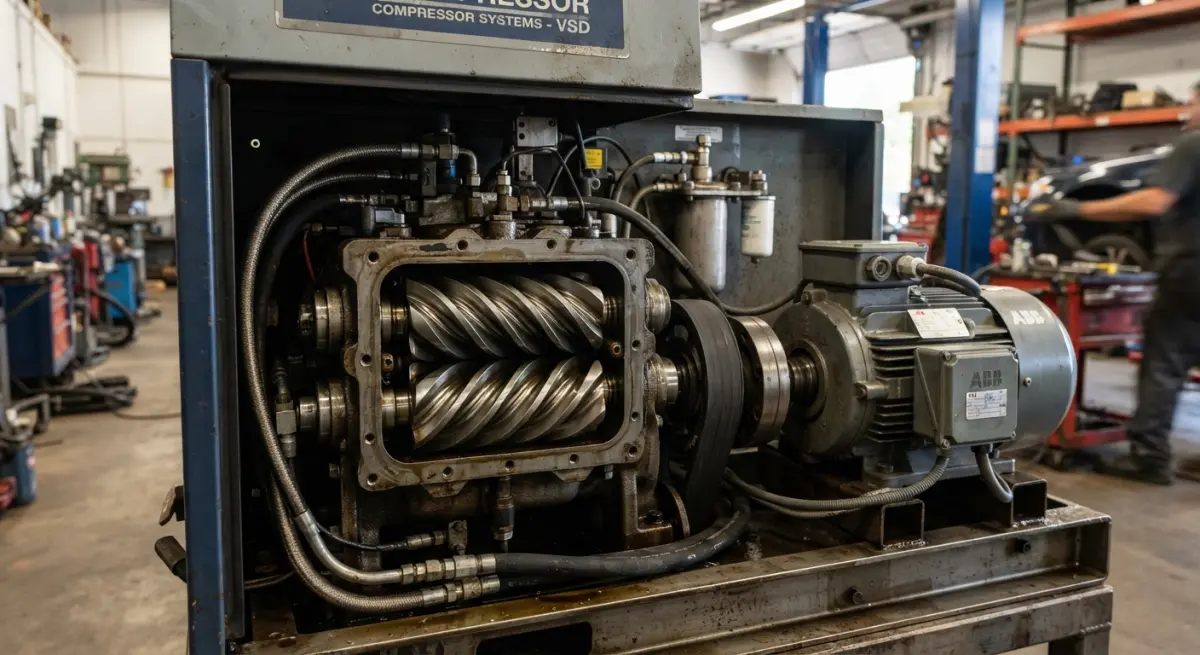
Air compressors convert electrical energy into pneumatic power, and electricity accounts for the vast majority of an industrial compressor’s total lifetime operating cost. Running an undersized or improperly matched piston unit continuously draws substantial amperage while delivering relatively low air volume per horsepower.
Rotary screw designs feature superior volumetric efficiency, producing noticeably more CFM per kilowatt of electrical input compared to reciprocating machines of similar sizing. Furthermore, as workshops grow and develop variable air requirements throughout the day, modern screw compressors provide advanced control options. Exploring a fixedspeed vs vfd air compressor which is right for your factory floor helps workshop owners understand how variable frequency drive (VFD) technology matches motor output directly to real-time air usage, preventing the energy waste of running an idling motor during quiet hours.
Air Quality, Downstream Finishing, and Tool Longevity
Air quality directly affects your repair quality and shop operating overhead. Auto workshops that feature professional paint booths or delicate pneumatic electronic diagnostic tools cannot tolerate moisture or oil carryover. Piston compressors discharge air at much higher temperatures, which holds more moisture in vapor form until it cools inside your distribution drop lines, creating liquid water at the tool outlet.
Rotary screw units discharge cooler air and incorporate high-efficiency spin-on air/oil separators that keep downstream oil carryover to a bare minimum. When paired with downstream treatment, they provide a reliable foundation for paint booths. Many workshop owners discover that investing in clean, dry air by researching why factories need a refrigerated air dryer protects thousands of dollars worth of pneumatic tools from internal corrosion while completely eliminating moisture-related paint rework.
Noise Pollution and Workshop Floor Ergonomics
The acoustic footprint of your air compressor plays an important role in technician comfort, communication, and occupational safety. Reciprocating compressors produce low-frequency pulsing, mechanical clatter, and heavy vibration that can make working nearby exhausting and communication difficult. Because of this noise, workshops frequently place piston compressors outside under makeshift sheds, exposing them to rain, heat, and dirt.
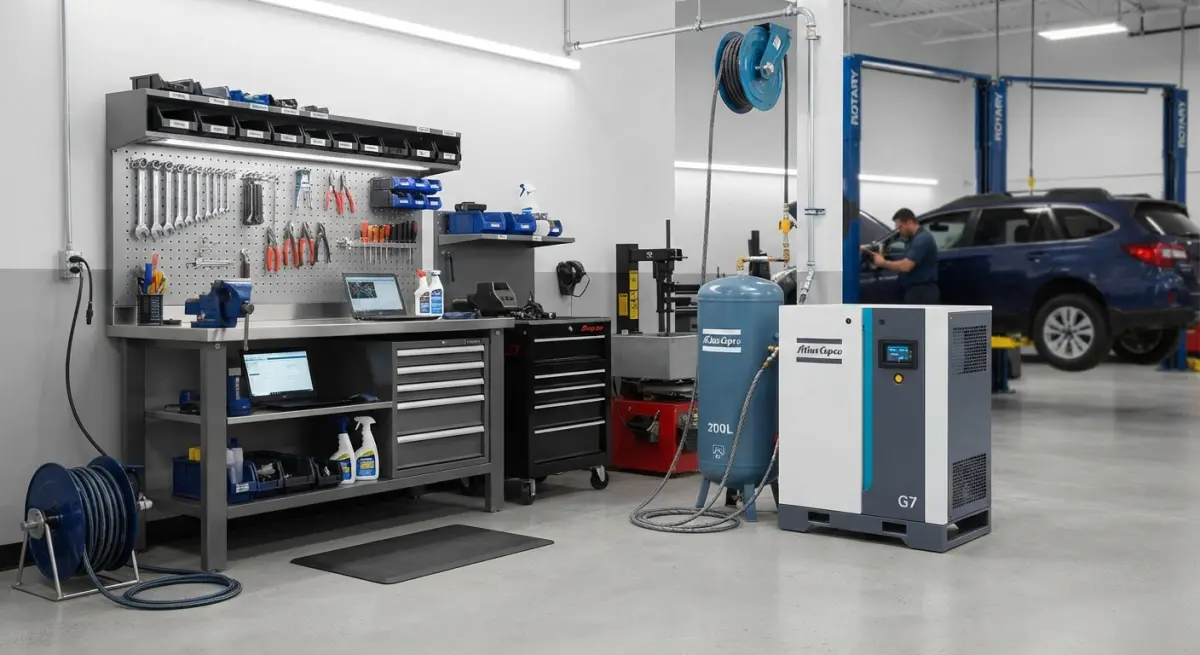
Screw compressors, by comparison, operate on smooth rotational motion rather than violent reciprocating action. Most modern rotary screw packages come fully enclosed in sound-attenuating steel cabinets with isolated vibration pads. They run quietly enough to be installed directly on the workshop floor adjacent to service bays without disrupting daily communications or causing operator fatigue.
Practical Scenarios: When the Upgrade Makes Financial Sense
To decide whether the switch is cost-effective for your specific operation, consider these everyday operational scenarios:
- The Expanding Paint and Prep Bay: If your shop is adding an enclosed paint booth or expanding body preparation to include continuous sanding, a piston compressor cannot keep up with continuous air draw. The labor cost and paint materials wasted on a single ruined paint job due to moisture contamination or pressure drop can quickly outweigh the monthly lease or financing payment of a screw package.
- The Multi-Bay Busy Service Center: When you operate five or more active bays where tire changers, air ratchets, and lift safety locks are triggered simultaneously throughout the day, line pressure fluctuations cause technicians to wait for the tank to rebuild pressure. Recovering those lost technician hours adds direct gross margin back to your bottom line.
- High Ambient Heat Environments: If your workshop operates in hot southern climates, piston units run dangerously hot during peak summer afternoons, leading to frequent thermal trip-outs and oil carbonization. A properly engineered screw unit manages heat far more predictably under tough conditions.
Taking the Next Step for Your Workshop
Switching from a piston to a rotary screw compressor is not simply an equipment replacement; it is a foundational upgrade to your workshop’s production capacity. When your air demand shifts from short, intermittent bursts to steady, continuous consumption, a rotary screw compressor pays for itself through lower energy consumption per delivered CFM, significantly longer equipment life, reduced downtime, and improved workshop safety.
If your growing auto workshop is struggling with constant noise, dropping line pressures, or moisture contamination in your air lines, it is time to assess your compressed air layout. You can request an air compressor quote from the engineering team at sk air solutions to find an appropriately sized screw compressor configuration tailored to your workshop’s specific workflow and expansion plans.
Frequently Asked Questions
How many technicians or active air tools justify upgrading to a rotary screw compressor?
Upgrading becomes cost-effective when a shop expands to 3 or 4 technicians simultaneously running air-demanding tools like impacts, sanders, or paint sprayers. Piston compressors struggle with duty cycles above 60%, leading to pressure drops that stall multiple bays, whereas a screw compressor provides continuous flow. If tool lag is causing unbillable labor time, the operational productivity gains will quickly offset the switch.
What is the total cost of ownership difference between piston and rotary screw compressors?
While rotary screw compressors have an initial purchase price 2 to 3 times higher than piston units, they consume roughly 20-30% less electricity per CFM delivered. Piston units wear out faster under heavy loads, driving up repair and replacement costs, whereas screw compressors easily last 10 to 15 years with minimal maintenance. For a growing shop running equipment all day, the energy and labor savings typically balance the cost difference within 18 to 24 months.
How does 100% duty cycle in rotary compressors reduce downtime in auto body shops?
Unlike piston compressors that must rest 30% to 50% of the time to avoid catastrophic overheating, rotary screw compressors are engineered to run at 100% continuous duty. This non-stop capacity eliminates pressure fluctuations during critical jobs like vehicle painting or media blasting, preventing costly rework. By removing forced cooling breaks, the shop maximizes billable bay hours and maintains consistent turnaround times.
Can switching to a rotary screw compressor lower my auto shop's energy bill?
Yes, especially if you invest in a variable speed drive (VSD) rotary screw model that automatically matches motor output to real-time air consumption instead of running full-bore. Piston compressors create high amp spikes every time they cycle on and off, resulting in peak-demand utility charges during busy shop hours. By operating at higher CFM-per-horsepower efficiency and modulating based on demand, rotary units dramatically cut annual electricity waste.
How do air quality and oil carryover compare between piston and screw air compressors?
Piston compressors run hot and use piston rings that degrade over time, leading to significant oil carryover that ruins pneumatic tools and contaminates paint finishes. Rotary screw compressors operate at cooler internal temperatures and feature integrated multi-stage air-oil separation that limits carryover to less than 3 ppm. This superior air purity preserves expensive diagnostic tools, prevents fish-eye defects in paint booths, and reduces filter replacement costs.
Also read: Air Compressor Setup for Rice Mills and Grain Processing: Dust Protection and Continuous Uptime