
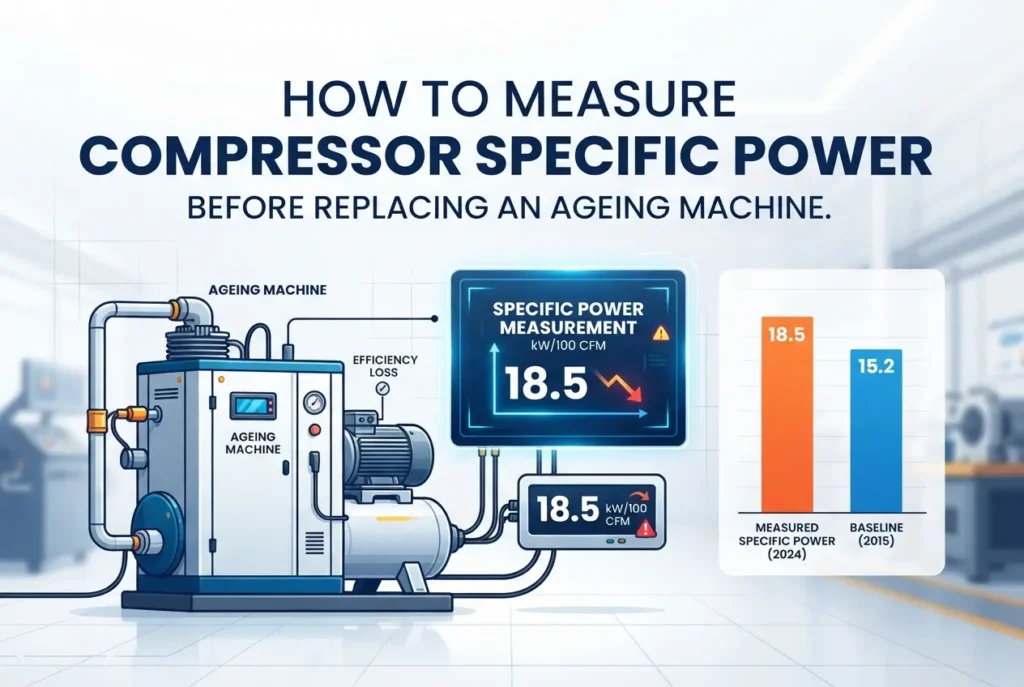
If you are staring at an ageing compressor and wondering whether it is time to replace it, the first question should not be “how old is it?” but “how efficiently does it turn electricity into compressed air?” That efficiency has a name: specific power. It is the single most useful number for deciding whether a machine still earns its place on your factory floor or is quietly draining your electricity budget.
Many plants replace compressors based on breakdown frequency or a gut feeling. Others hold on too long because the machine “still runs.” Both approaches can be expensive. Measuring specific power gives you an evidence-based baseline, so you can compare your current machine against a new one and make a decision you can defend to your finance team.
In this guide, we walk through what specific power means, how to measure it properly on site, and how to use the results before you commit to a replacement.
What Is Compressor Specific Power?
Specific power is the electrical power the compressor package draws for each unit of air it delivers. It is usually expressed as kW per 100 CFM, or kW per m³/min. A lower number means the machine is more efficient. A rising number over the years tells you the machine is working harder to deliver the same air.
The key point is that it is measured at the package level: total input power at the motor and fans, divided by actual free air delivered. That is different from the nameplate motor rating, which tells you almost nothing about efficiency. A big motor does not mean a poor machine, and a small one does not mean a good one.
Specific power is also best understood at a given pressure. Higher discharge pressure needs more power, so always note the pressure at which you measure. If you are unsure whether your system pressure is set higher than necessary, read why operating above 7 bar wastes power sizing header pressure to match tool requirements before you test, because correcting pressure may change your results.
What You Need to Measure It
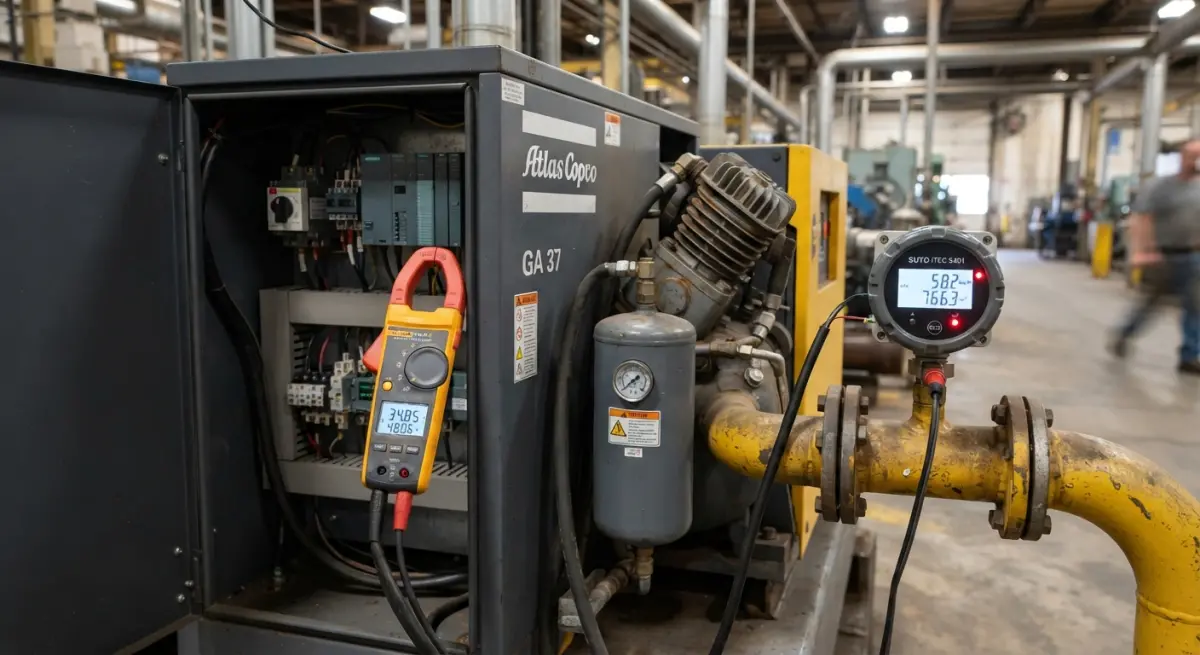
You need two measurements taken at the same time: electrical input and air output.
- Electrical input: Use a power analyser or clamp-type power meter on the compressor supply to log kW, not just amps. Amps alone ignore power factor and can mislead you. If the machine has a panel meter, verify it against a calibrated instrument.
- Air output: This is the harder half. Options include a flow meter installed downstream of the compressor, a receiver fill-up test, or the manufacturer’s performance test data for comparison.
- Pressure and temperature: Record discharge pressure, ambient temperature and intake conditions. Hot ambient air reduces delivered volume, which matters a lot in summer conditions.
Before connecting any equipment, check the supply and protection arrangement so measurement is safe. Our air compressor installation electrical checklist supply voltage starting current and protection is a useful reference for what to look at on the panel side.
Step-by-Step: Running the Test
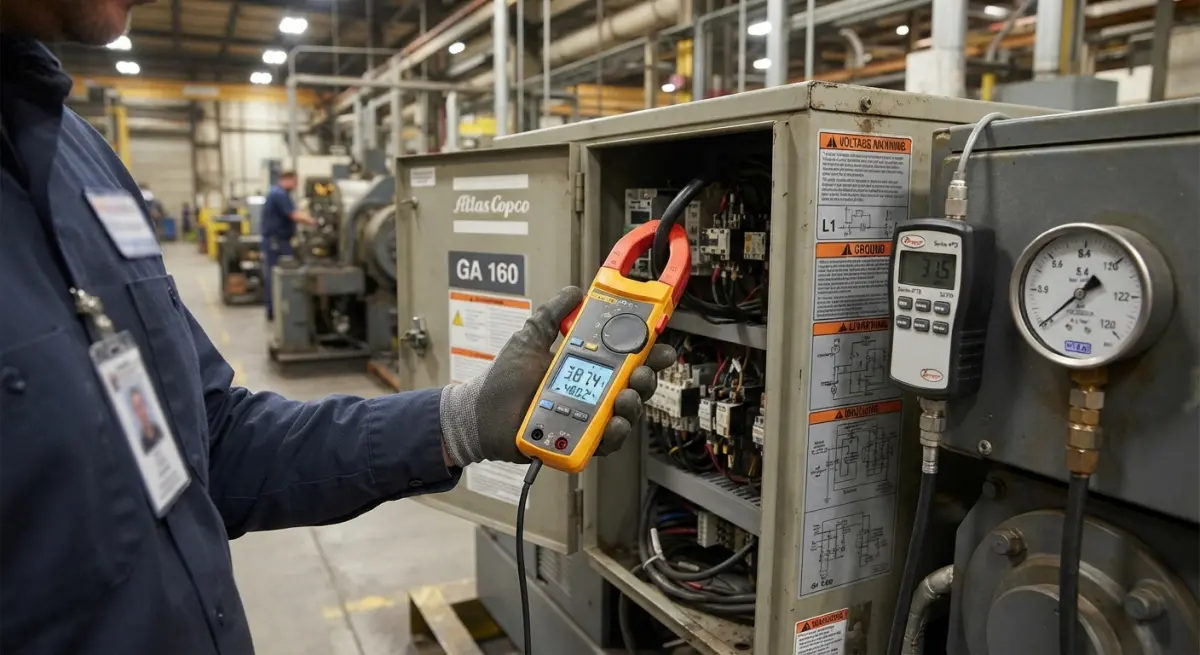
1. Prepare the machine
Service the compressor first, or at least confirm that filters are clean and oil level is correct. A blocked intake filter or clogged separator will inflate your specific power and make a good machine look bad. If the machine runs hot, resolve that too; see why screw compressors overheat in south tamil nadu summers and how to fix it.
2. Fix the operating condition
Run the compressor fully loaded at its normal working pressure. Isolate it from other compressors if possible so you are testing it alone. Unloaded running distorts the figures, since the machine is consuming power without delivering air.
3. Log power and flow together
Record kW and flow at regular intervals over a representative period. A short snapshot can be misleading, so capture enough time to see the machine’s typical behaviour. Then divide average kW by average delivered flow to get your specific power.
4. Compare against a benchmark
Compare your number to the original commissioning data, if you have it, and to the specific power quoted on a modern machine’s datasheet at the same pressure. The gap between the two is the efficiency you could recover by replacing.
Account for Unloaded Hours and System Losses
Specific power at full load only tells part of the story. On a fixed-speed machine, the hours spent running unloaded can be a major hidden cost, because the motor keeps drawing considerable power while producing no air. Learn how to quantify this in how to measure and mitigate unloaded running hours on fixedspeed industrial compressors.
If your demand fluctuates widely, a variable-speed machine may beat a fixed-speed one even if their full-load figures look similar. The comparison in fixedspeed vs vfd air compressor which is right for your factory can help you decide.
Also check whether the problem is really the compressor. Leaks, poor piping and undersized receivers can make a healthy machine look inefficient or force it to work harder. An how to conduct an ultrasonic compressed air leak audit in manufacturing plants is often a cheaper first step than replacement.
Practical Tips Before You Decide
- Test at the same pressure each time so comparisons are fair.
- Repeat the test after servicing. If specific power improves significantly, you may have bought yourself more years.
- Consider the airend. A high specific power may point to worn rotors or bearings. Compare repair economics using rotary screw airend rebuilding vs replacement calculating remaining bearing life and costs.
- Right-size the replacement. Re-check your demand with how to calculate air compressor cfm for your factory so you do not buy a machine that is too large.
As a simple example, imagine two machines delivering the same air at the same pressure. If the older one draws noticeably more kW, multiply that difference by your annual running hours and your tariff. That gives a real rupee figure for the efficiency gap, which you can set directly against the cost of a new machine.
Conclusion
Measuring specific power turns a vague feeling about an ageing compressor into a clear, comparable number. Test under stable conditions, log power and flow together, account for unloaded hours, and rule out leaks and maintenance issues before you blame the machine. If the numbers show a real efficiency gap, replacement becomes a straightforward business case rather than a guess.
If you would like help measuring your compressor’s performance or choosing a replacement, the team at SK Air Solutions can support you across South Tamil Nadu. Request an air compressor quote or explore our air compressor service 038 amc in south tamil nadu options to get started.
Frequently Asked Questions
How do I calculate compressor specific power for an air compressor?
Specific power is the electrical input power (kW) divided by the free air delivery (m³/min or cfm) at a stated working pressure. Measure input power with a calibrated power meter on the compressor's supply and measure airflow with a flow meter or a controlled receiver fill-up test. Express the result as kW/(m³/min) or kW/100 cfm, and record the discharge pressure so you can compare against the manufacturer's rated figure.
What is a good specific power value for a rotary screw compressor, and how does my ageing machine compare?
Modern oil-injected rotary screw compressors typically achieve about 6.0 to 7.0 kW per m³/min (roughly 17 to 20 kW per 100 cfm) at 7 to 8 bar(g) at full load, with variable speed and two-stage models often doing better. If your measured figure is more than 10 to 15 percent worse than the original datasheet or current benchmark models, wear, fouled coolers, or internal leakage are likely reducing efficiency. This gap helps justify a repair or replacement.
What instruments do I need to measure compressor specific power on-site?
You need a true RMS power analyser or data logging kW meter for electrical input, a pressure gauge or transducer at the compressor discharge, and a flow measurement method such as a thermal mass flow meter, orifice plate, or a receiver pressure-rise test. Add a temperature sensor for inlet air so you can correct flow to standard conditions. Logging over a representative period, ideally a full production cycle, gives a far more reliable picture than a single spot reading.
Why does my compressor's measured specific power differ from the nameplate or datasheet value?
Datasheet values are measured under standard test conditions such as ISO 1217, with specific inlet temperature, pressure, and full-load operation. In the field, differences come from higher ambient temperatures, dirty filters and coolers, worn airends, unloaded running, pressure setpoints, and measurement errors. Correct your readings to standard conditions and test at full load to get a fair comparison.
How can I use specific power results to decide whether to replace an ageing compressor?
Multiply the difference in specific power between your current machine and a new one by annual airflow demand, running hours, and your electricity price to estimate yearly energy savings. Compare that saving, plus avoided maintenance and downtime costs, against the purchase and installation cost to find the payback period. If payback is under about 2 to 4 years, or a variable speed drive would better match your demand profile, replacement is usually financially justified.