
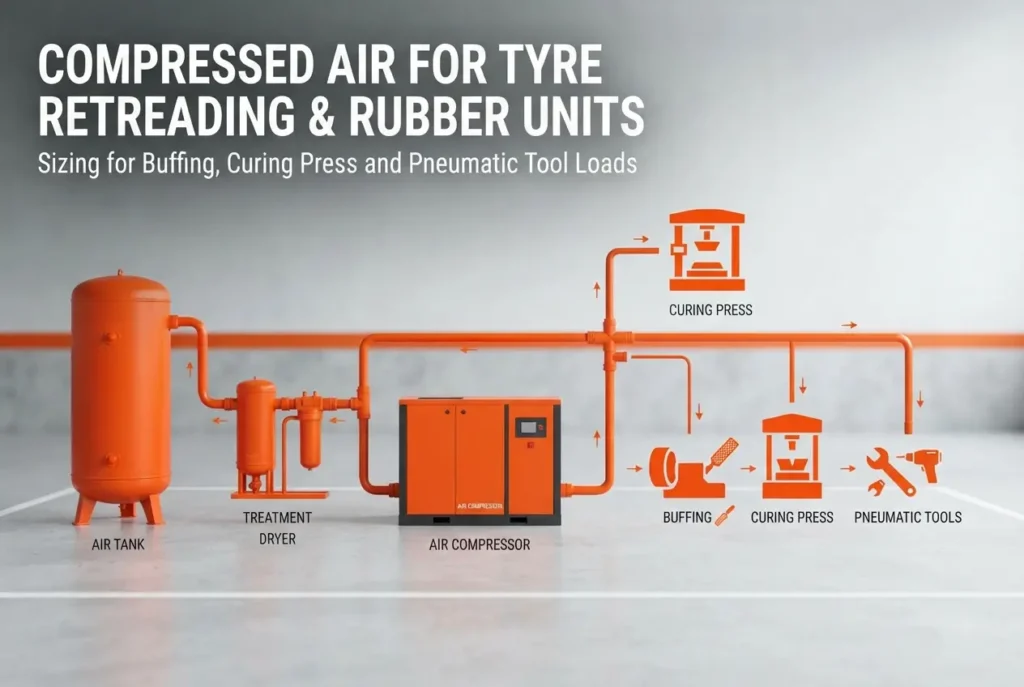
Walk into any tyre retreading shop and you will hear compressed air before you see it. Buffing rasps run on pneumatic spindles, curing presses cycle their bladders, and hand tools hiss along the bays. Rubber product units making gaskets, mats, hoses and moulded parts have a similar mix of steady and spiky demand. All of it sits on one compressor system, and it is rarely sized with that mix in mind.
The usual result is a compressor picked on horsepower or price alone. The curing press starves when the buffer runs hard, tools lose power at the far end of the shop, and moisture ends up in places it should never reach. This guide shows how to size compressed air for retreading and rubber units by looking at each load separately before you add them up.
Understand the Three Load Types
Retreading and rubber plants have three different air consumers, and each behaves differently.
Buffing and rasping. Pneumatic buffing machines and spindle drives consume air steadily while the tyre is being worked. They are continuous-duty loads and are sensitive to pressure. If pressure sags, rasp speed drops, the texture of the buffed casing becomes inconsistent, and operators compensate by pushing harder.
Curing presses. Presses and chambers use air for clamping, bladder operation, valve actuation and sometimes pressurising the cure. Demand is cyclic. A large volume is drawn when a press closes or a chamber is pressurised, then very little during the cure. This is the load that causes sudden pressure dips on an undersized system.
Pneumatic hand tools. Impact wrenches, die grinders, spray guns, needle scalers and cleaning guns are intermittent, but they add up when several are used at once. Their combined draw is the easiest to underestimate.
Build the Demand Profile, Not Just a Total
Start with a list of every air consumer, its rated consumption in CFM or litres per minute, the pressure it needs, and how often it runs. Then apply a realistic utilisation factor. Not every tool runs at the same time, but the buffers, presses and tools that overlap in a normal shift must be added together at their peak.
If you need a refresher on the arithmetic, our guide on how to calculate air compressor cfm for your factory walks through it step by step. Add a margin for future machines and for normal leakage, but keep it sensible. A hugely oversized compressor running unloaded wastes power, a point covered in how to measure and mitigate unloaded running hours on fixed-speed industrial compressors.
Set the Pressure by the Tool, Not by Habit
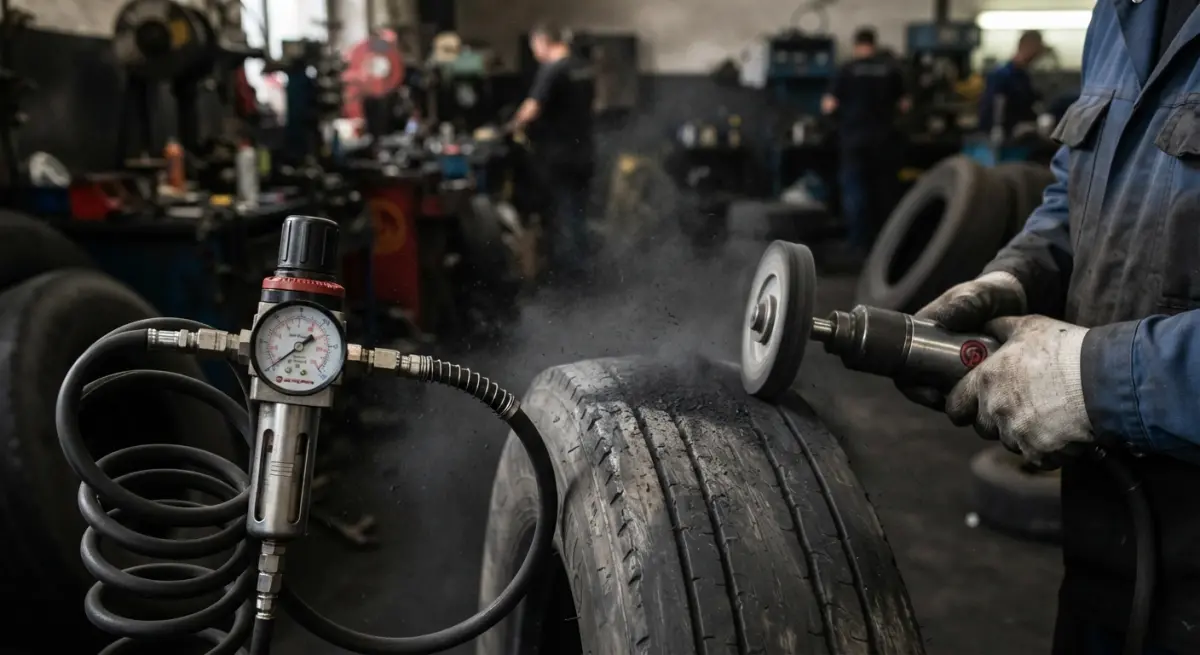
Most buffing and hand tools are designed around a working pressure at the tool, commonly in the region of 6 to 7 bar. Curing equipment may need more, and that should be treated as a separate duty. Running the whole plant at a higher header pressure to satisfy one machine costs energy continuously. Read why operating above 7 bar wastes power before deciding on a plant-wide setting. If one process truly needs much higher pressure, a dedicated booster is usually smarter than lifting the whole system, an idea explored in compressed air for PET bottle blow moulding and plastic injection units.
Use Storage to Handle Press Spikes
Because curing presses draw air in bursts, a correctly sized receiver is often cheaper than a bigger compressor. The receiver supplies the short surge and lets the compressor recover gradually. It also stops short-cycling, which wears starters and wastes energy. The principles are explained in how to size an air receiver tank to prevent compressor short-cycling, and they apply equally to a press shop. Place the receiver close to the press line where possible, and consider a separate receiver for the heaviest cyclic consumer.
Protect Quality: Dust, Moisture and Oil
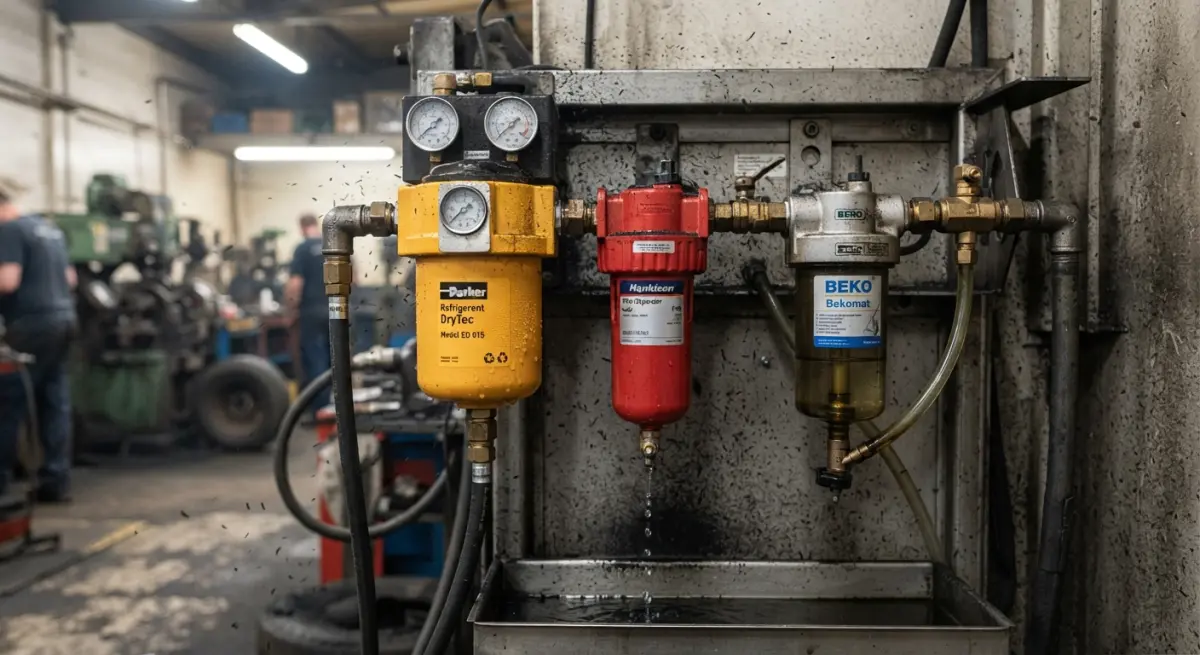
Buffing generates rubber dust, which is hard on a compressor intake and cooling system. Keep the compressor out of the buffing bay, in a ventilated room with clean intake air. Moisture is the other enemy. Water in the lines damages pneumatic tools, causes sticky valves and can spoil bonding and spray operations. A refrigerated dryer is normally the baseline, and why factories need a refrigerated air dryer explains the reasoning. Pair it with proper filtration, as described in coalescing vs particulate downstream line filters.
Practical Tips and a Worked Example
Consider a mid-size retreading shop with two buffing machines, four curing presses, and a dozen hand tools in use at various times. Rather than adding every nameplate figure, do this:
- Add the continuous buffer demand in full, since both usually run together.
- Estimate how many presses are likely to close or pressurise within the same minute, and size storage for that surge.
- Apply a realistic simultaneity factor to the hand tools, such as half to two-thirds in use at once, based on your own shift observation.
- Add allowance for leakage and expansion, then choose a compressor with comfortable headroom.
Then look at the load pattern. If demand swings widely between shifts, a variable-speed machine may suit better; fixed-speed vs VFD air compressor covers that decision. Pipe the plant with enough diameter to keep pressure drop low, and have leaks checked regularly, since rubber shops with flexible hoses and quick couplers tend to leak. A structured approach is outlined in how to conduct an ultrasonic compressed air leak audit.
Finally, remember that summer heat in South Tamil Nadu can push compressors to overheat, so allow for ventilation and cooling, as discussed in why screw compressors overheat in South Tamil Nadu summers.
Conclusion
Sizing compressed air for a retreading or rubber unit is about matching three very different loads: steady buffing, cyclic curing and scattered hand tools. Build the demand profile, set pressure by actual tool needs, use storage for press spikes, and protect the system from dust and moisture. Do that and you get stable pressure, consistent product quality and lower running costs.
If you are planning a new line or struggling with an existing one, the team at SK Air Solutions can help you assess demand and choose the right setup. Request an air compressor quote or browse our air compressors and compressed-air products to get started.
Frequently Asked Questions
How do I calculate the total compressed air demand for a tyre retreading plant with buffing, curing presses and pneumatic tools?
List every consumer with its free air delivery (CFM or m³/min), operating pressure and duty cycle, then multiply by a load factor. For example, add the buffer's spindle and dust-extraction air, press bladder and actuator consumption, and tool usage. Add 10-20% for leakage and 20-30% for future expansion. Sizing on the connected load alone usually oversizes the compressor, while using only the average load can cause pressure dips during peak buffing and press-closing cycles.
What air pressure and flow does a tyre buffing machine need, and how does it affect compressor sizing?
Most automatic and semi-automatic buffing machines run at 6-8 bar (90-115 psi). They use compressed air for chuck inflation, rasp-head positioning, clamping and sometimes dust-collection pulse cleaning. Individual draw is moderate but intermittent, so the buffer should be sized with its duty cycle in mind and supplied from a dedicated receiver to keep pressure stable during rasping.
How much compressed air does a tyre curing press use, and should I use a separate high-pressure supply?
Curing presses use air for mould opening and closing, clamping, bladder control and sometimes inflation or purging. Steam or hot water usually provides curing pressure and heat. Press demand is cyclical, with sharp peaks at each loading and closing step, so size receiver capacity to cover these peaks. If the process needs more than 10-14 bar, use a booster compressor on a dedicated line so the main system can stay at a lower, more efficient pressure.
What size air receiver tank and piping do I need to avoid pressure drops in a rubber product unit?
A common rule is 3-6 litres of receiver volume per litre/second (about 1 gallon per CFM) of compressor capacity. Use larger or additional receivers near cyclic loads such as curing presses. Size the piping for a total pressure drop under 0.3-0.5 bar from compressor to point of use, favouring a ring main with larger diameter pipes and minimal restrictions.
What air quality is required for tyre retreading and rubber moulding, and do I need dryers and filters?
Yes. Moisture, oil and particles can contaminate bonding surfaces, damage pneumatic tools and cause valve and cylinder failures in presses. Most plants need a refrigerated dryer (pressure dew point around 3°C) plus coalescing and particulate filters, aiming for ISO 8573-1 class 1-4 as specified for the application. Use desiccant dryers for lines exposed to freezing temperatures or for sensitive spraying and cementing operations, and drain condensate automatically.