
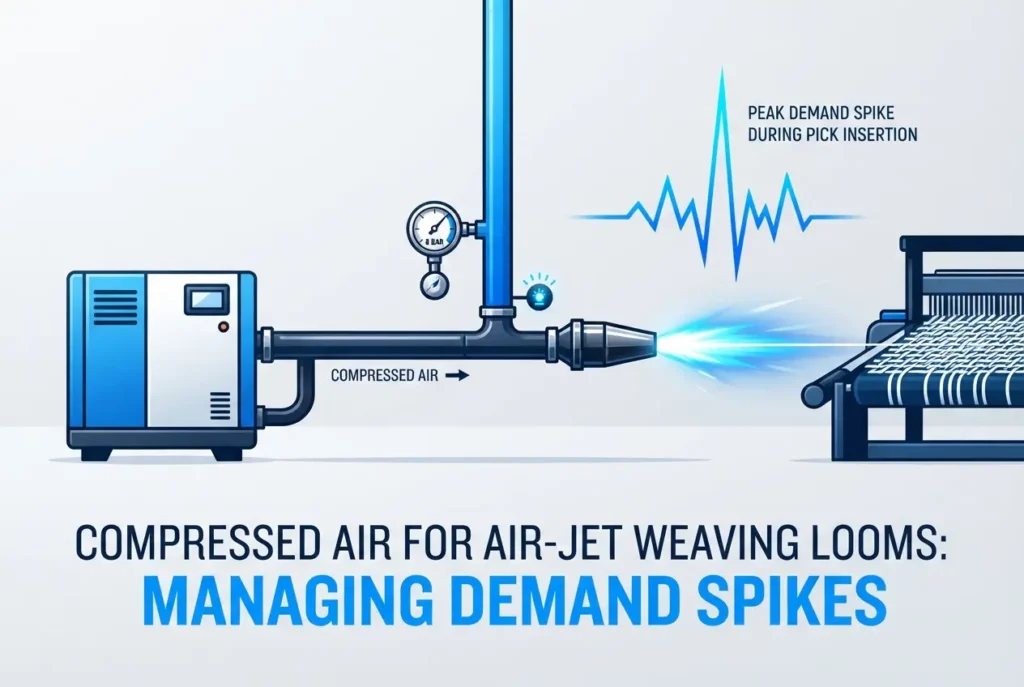
Walk through any air-jet weaving shed and you will notice something: the compressor room rarely sounds steady. Each time a loom fires its main nozzle and relay nozzles to carry the weft across the shed, it pulls a sharp burst of air from the system. Multiply that by dozens of looms running at several hundred picks per minute, and the demand on your compressed air network is anything but smooth.
That is why air-jet looms are among the most demanding compressed air users in a textile mill. The challenge is not just total volume. It is how quickly that volume is requested, and whether your system can deliver it without the header pressure dipping. A momentary sag can cause weft insertion faults, stop marks, loom stoppages and fabric quality complaints. This post explains why demand spikes happen during pick insertion and how to manage them with the right compressor, storage, piping and air treatment decisions.
Why Pick Insertion Creates Demand Spikes
In an air-jet loom, the weft yarn is carried across the warp shed by a main nozzle and a series of relay nozzles timed to fire in sequence. Each insertion is a rapid, repeated event. The loom is not drawing a constant stream; it is drawing short pulses, thousands of times per hour.
On a single loom this is manageable. Across a whole weaving shed, the pulses overlap and the combined draw changes constantly. If the looms are not synchronised, the load averages out somewhat. Still, the network must be able to ride through peaks without the pressure at the loom falling below what the nozzles need. Wider fabrics, heavier yarns and higher speeds all increase the air needed per pick, so the spikes grow as you push production.
Pressure stability matters more than raw capacity here. A compressor rated for the average flow can still fail the looms if it cannot respond quickly to the peaks.
Start With an Honest Flow Calculation
Good spike management begins with knowing your real demand. Gather the air consumption figures from the loom manufacturer for your fabric style and speed, then add allowances for other users such as cutters, tuck-in devices, cleaning guns and any auxiliary pneumatics. Include a margin for leakage and future loom additions.
If you have not done this recently, our guide on how to calculate air compressor CFM for your factory walks through the method. Remember that loom consumption changes with style changes, so size for your most demanding fabric, not your easiest one.
Use Receiver Storage as a Buffer
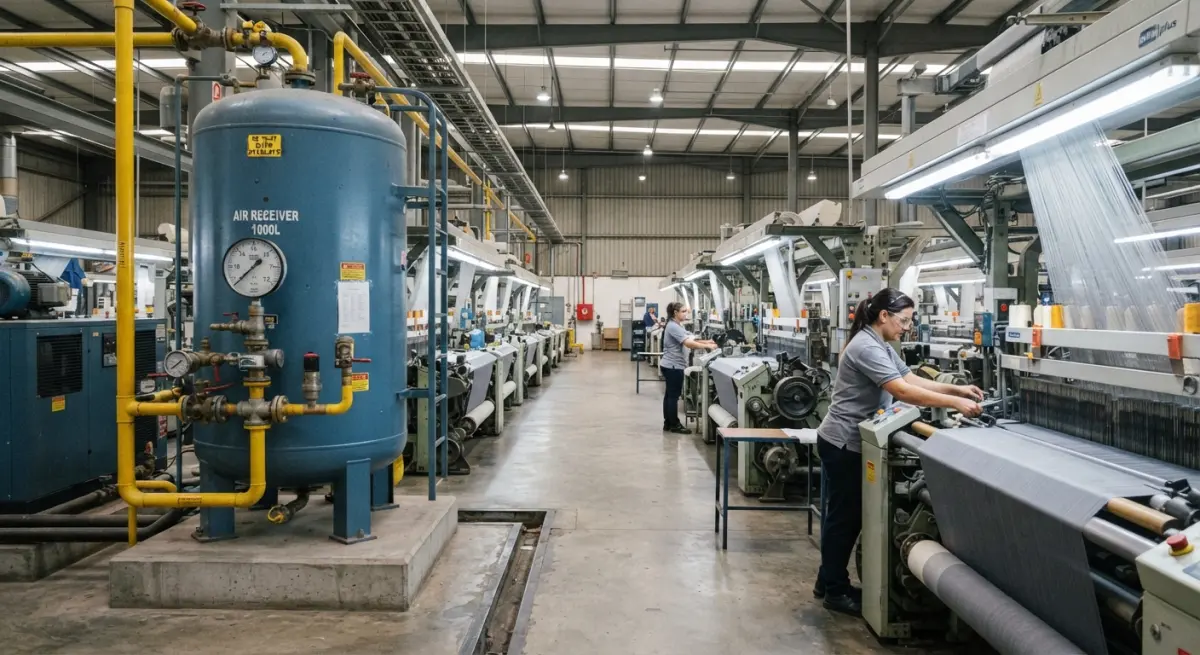
The most effective and affordable tool against short spikes is stored air. A properly sized receiver supplies the sudden gulps of air, giving the compressor time to respond and preventing the header pressure from collapsing. It also reduces load/unload hunting and short-cycling, which wastes energy and stresses motors and starters.
Placement matters too. A wet receiver close to the compressor helps stabilise the discharge, while a secondary dry receiver near the weaving shed supports the point of use where the spikes actually occur. For a detailed approach, see how to size an air receiver tank to prevent compressor short-cycling in textile units.
Choose the Right Compressor Control Strategy
Weaving loads tend to vary with shift patterns, style changes and loom stoppages, so control strategy is important. A fixed-speed machine on load/unload control can deliver reliable peak capacity but may spend considerable time running unloaded during lighter demand. A variable-speed machine follows demand more closely and can save energy, but it needs to be sized so it still covers peaks. Many mills do best with a base-load fixed-speed unit plus a VFD trim machine. Our comparison of fixed-speed vs VFD air compressor options covers the trade-offs.
Running multiple machines also gives you backup, which matters when a stopped compressor means idle looms. If you are weighing the layout, read one large compressor or two smaller units before deciding.
Piping, Pressure Drop and Air Quality

Even with ample compressor capacity, poor distribution can starve the looms. Undersized headers, long dead-end runs and restrictive fittings create pressure drop precisely when the spikes hit. A ring main usually gives the looms two feed paths and steadier pressure; compare options in loop (ring main) vs dead-end air header piping.
Air quality is the other half of the story. Moisture and oil in the air can foul nozzles, mark yarn and make valves sticky. A refrigerated dryer and suitable filtration are standard for weaving, and our article on why factories need a refrigerated air dryer explains the reasoning. Filter selection also affects pressure drop, so see coalescing vs particulate downstream line filters to avoid choking the flow.
Practical Tips for Weaving Sheds
- Measure before you modify. Log pressure at the compressor outlet and at the farthest loom. The gap between them shows where the losses are.
- Do not raise set pressure as a cure-all. Higher pressure increases energy use and leakage. Fix storage and piping first.
- Audit leaks regularly. Leaks quietly eat into the capacity you need for peaks; an ultrasonic leak audit is a fast way to recover it.
- Keep the compressor room cool. Heat reduces delivery and trips machines at the worst time, particularly in summer.
- Plan for expansion. If you will add looms, leave room in the receiver volume, pipe diameter and compressor capacity.
Conclusion
Managing demand spikes in air-jet weaving is about the whole system working together: accurate flow calculations, adequate storage, a sensible compressor control strategy, low-loss piping and clean, dry air. Get those right and the looms run at speed with fewer weft faults and stoppages.
If your mill is seeing pressure dips, unexplained loom stops or rising energy costs, the team at SK Air Solutions can help you assess the system. Explore our air compressor service & AMC in South Tamil Nadu, or request an air compressor quote to discuss a setup built for your weaving shed.
Frequently Asked Questions
Why does compressed air demand spike so sharply during pick insertion on air-jet looms?
Each weft insertion requires the main nozzle and a sequence of relay nozzles to fire in rapid succession, often within 20-40 milliseconds per pick at speeds of 600-1,000+ picks per minute. When dozens or hundreds of looms fire at once, the combined short bursts create pulsating flow demand that can far exceed average consumption. This causes pressure dips at the loom headers if supply and storage aren't sized for peak flow rather than average flow.
How much compressed air storage capacity do I need to buffer demand spikes in a weaving shed?
A common approach is to size receiver volume based on peak flow, allowable pressure drop, and the duration of the event, using V = (C × Pa) / ΔP, where C is the flow deficit between demand and compressor supply. Many mills use a combination of a large primary receiver near the compressors and smaller secondary receivers near loom groups to deliver air where bursts occur. A system audit with flow and pressure logging is the best way to find the right volume for your loom count and pick rate.
What pressure drop is acceptable at air-jet looms before weft insertion quality suffers?
Most air-jet loom manufacturers recommend a stable supply pressure at the loom of about 5.5-7 bar, and a drop of more than 0.2-0.5 bar during insertion can cause weft stops, late arrivals, or inconsistent yarn tension. Even brief dips can lead to fabric defects like stop marks and reduced loom efficiency. Monitor pressure at the loom inlet rather than at the compressor room, since line losses and spikes show up only at the point of use.
Can flow controllers or pressure/flow regulators help manage air-jet loom demand spikes?
Yes, a pressure/flow controller installed between the plant's supply side and the weaving shed's distribution header decouples fluctuating loom demand from compressor control. It maintains a stable downstream pressure while allowing stored air in upstream receivers to supply the short bursts, so compressors don't have to cycle or run at unnecessarily high discharge pressure. This usually reduces artificial demand and energy costs while improving weft insertion consistency.
How can I reduce overall compressed air consumption in air-jet weaving without hurting loom performance?
Start by optimizing relay nozzle timing and pressure settings for each fabric style, replacing worn nozzles, and fixing leaks, which can account for 20-30% of total air use. Using correctly sized piping with loop headers, lowering supply pressure to the minimum stable level, and applying variable speed drive compressors with sequencing controls also cut energy waste. Track specific energy (kW per 100 cfm or kWh per meter of fabric) to verify that each change delivers savings without increasing weft breaks.