
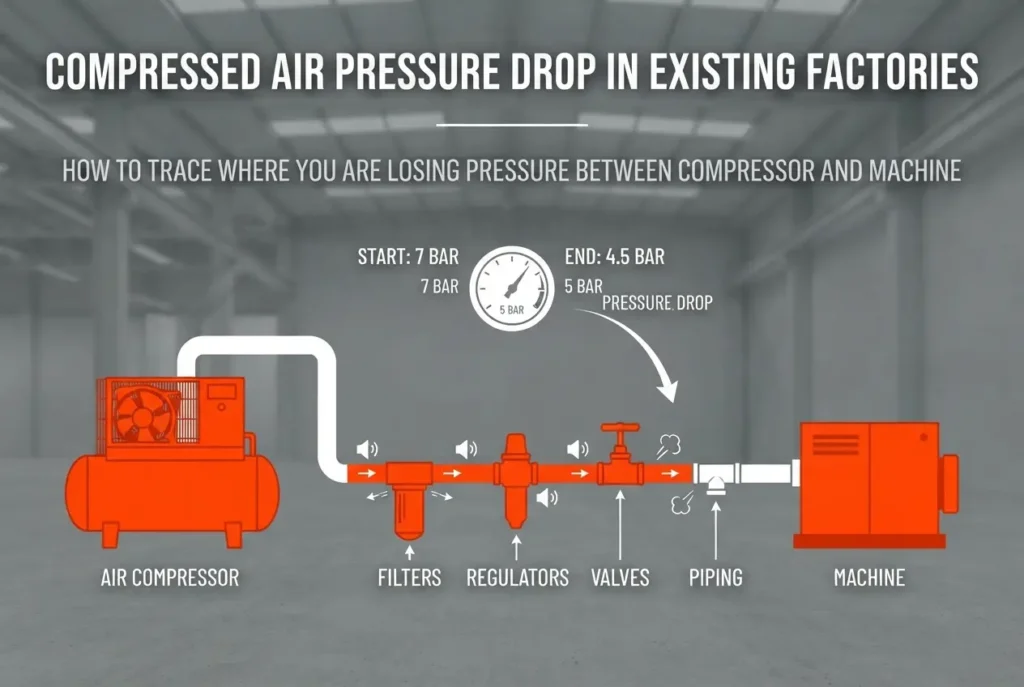
Every plant manager has heard the same complaint from the shop floor: “The compressor says 7 bar, but my machine is starving.” The gauge at the compressor looks healthy, yet a cylinder moves slowly, a blow gun feels weak, or a packaging line stalls at peak demand. Almost always, the pressure is being lost somewhere between the compressor outlet and the point of use.
In an existing factory, this is rarely a single dramatic fault. It is usually a collection of small restrictions, leaks and mismatches that have built up over years of expansion. A new machine gets tapped into an old header, a filter is left unchanged, a few metres of hose are added. Each change seems harmless, but together they cost you pressure, and operators respond by raising the compressor setpoint, which burns more power.
This guide walks through a practical, step-by-step method to trace where pressure is disappearing, using tools most maintenance teams already have or can borrow easily.
Understand What Pressure Drop Actually Is
Pressure drop is the difference between the pressure leaving the compressor system and the pressure arriving at the machine. Air loses energy as it moves through pipes, bends, valves, filters, dryers, couplings and hoses. Some drop is unavoidable. The goal is to keep it modest and to know where it occurs.
Drop gets worse when flow increases, because resistance rises sharply with velocity. That is why a system can seem fine at night and struggle during a busy shift. It is also why simply raising the discharge setpoint is a poor fix. As explained in why operating above 7 bar wastes power and how to size header pressure to match tool requirements, higher pressure costs more energy and also increases leakage from every open point in the network.
Step 1: Build a Pressure Profile with Gauges
The simplest and most useful tool is a set of reliable, calibrated gauges. Fit or temporarily install them at key points and record readings at the same time, ideally during peak demand:
- Compressor discharge, before the dryer
- After the dryer and receiver
- Before and after each major filter
- Start, middle and end of the main header
- At the inlet of the farthest or most problematic machine
Plot these numbers in order along the air path. The step changes show you where the losses sit. A big gap across a filter points to a clogged element. A gradual slope along the header points to undersized or corroded pipe. A sudden fall at the final branch points to hoses, quick couplings or regulators.
Use the same gauge, or gauges checked against each other, because cheap gauges can disagree by more than the drop you are chasing.
Step 2: Check the Usual Suspects at the Plant Room
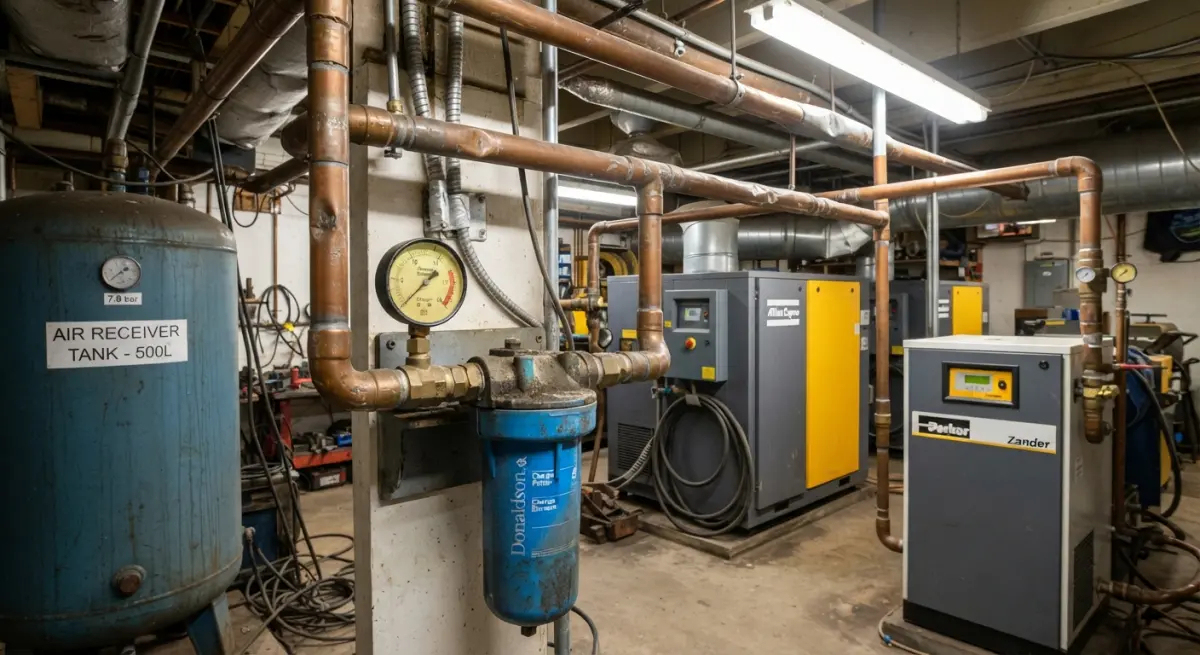
Start at the source. Several restrictions hide inside the compressor room itself.
- Filters: Dirty or wrongly selected elements are a classic cause. Review coalescing vs particulate downstream line filters and their replacement intervals to make sure you are using the right grade and changing it on schedule.
- Dryer: An undersized or overloaded dryer adds restriction and can leave moisture in the line. Hot inlet air makes this worse, as covered in how to size a refrigerated air dryer for hot inlet air and South Tamil Nadu summer temperatures.
- Receiver and valves: Partially closed isolation valves and undersized outlet connections quietly throttle flow.
- Condensate drains: A stuck or leaking drain wastes air and can let water collect in low points.
Step 3: Inspect the Distribution Piping
Once the plant room is cleared, walk the header. Older factories often have pipe that was sized for a smaller compressor. Look for reduced diameters, long dead-end runs, many elbows, and old galvanised pipe with internal rust that narrows the bore and sheds scale into tools.
Layout matters as much as diameter. In a dead-end header, machines at the far end suffer when upstream users draw heavily. A ring main feeds each point from two directions and usually evens out pressure. See loop (ring main) vs dead-end air header piping for how to decide. If you are replacing pipe, the comparison in aluminum vs GI piping for industrial compressed air helps weigh smooth-bore performance against cost.
Step 4: Hunt Down Leaks and Point-of-Use Restrictions
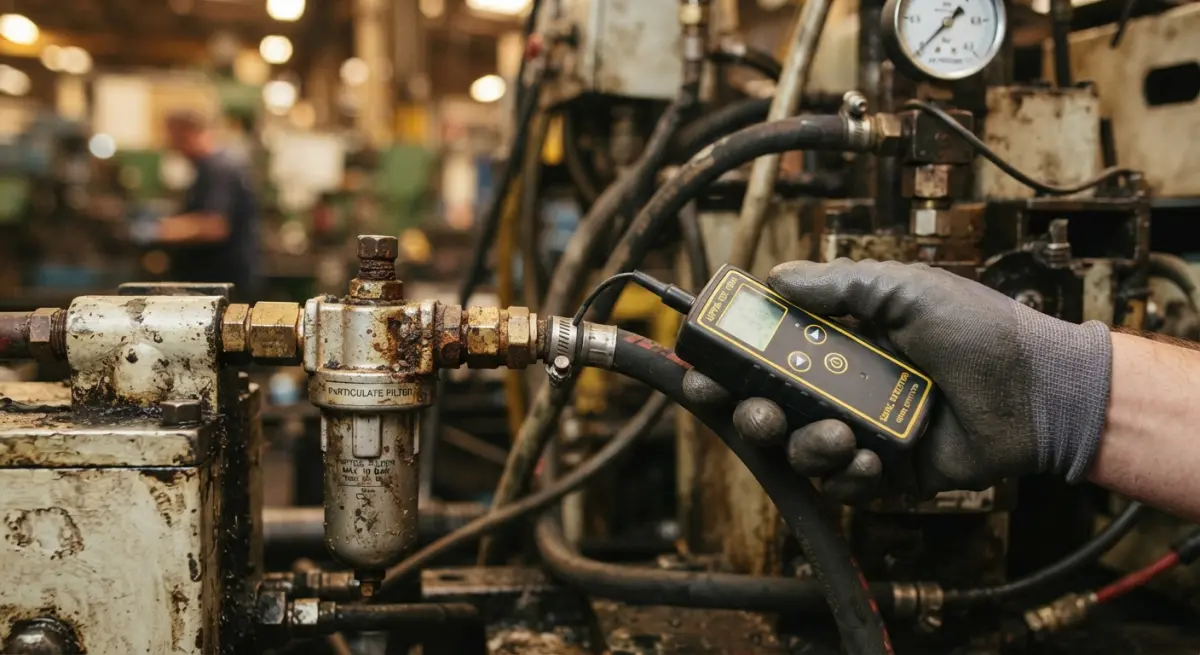
Leaks behave like extra machines that never switch off. They increase flow through the pipes, and higher flow means higher drop everywhere. An ultrasonic detector is the fastest way to find them; the process is laid out in how to conduct an ultrasonic compressed air leak audit in manufacturing plants.
At the machine, check the last few metres closely. Common culprits include:
- Long, small-bore hoses or coiled hoses used far beyond their intended length
- Quick couplings with a smaller bore than the hose
- Regulators and FRL units too small for the machine’s peak flow
- Clogged filter bowls and sintered elements
Practical Example: The Starving Machine at the End of the Line
Imagine a packaging line at the far end of a factory that loses pressure whenever a second shift starts. A maintenance team fits gauges and finds the compressor outlet at the set pressure, a modest drop across the dryer, and a much larger drop across a line filter that is overdue for replacement. Further along, the header narrows where a previous expansion joined a smaller pipe, and the final branch uses a long thin hose with a small coupling.
No single item looks catastrophic, yet together they leave the machine well short of what it needs. The fix is not a bigger compressor. It is a new filter element, a larger pipe at the bottleneck, a shorter, wider hose and a leak repair round. The operators can then lower the setpoint, saving energy.
Practical Tips to Keep Pressure Where You Need It
- Log pressure at several points regularly, not only when there is a complaint.
- Fit differential gauges across filters so replacement is based on condition.
- Check actual demand before blaming supply, using how to calculate air compressor CFM for your factory as a reference.
- Consider an adequately sized receiver near large intermittent users to buffer demand spikes.
- Keep a drawing of your piping, updated every time a machine is added.
- Include pressure-drop checks in your service plan, such as an air compressor service and AMC in South Tamil Nadu.
Conclusion
Pressure drop is a systems problem, and the way to solve it is to measure, not guess. Map the pressure from compressor to machine, find where the steps occur, and fix the biggest restrictions first: filters, undersized pipe, leaks and the last few metres of hose. Done well, you will often be able to reduce the compressor setpoint, cut energy use and give your machines the stable pressure they need.
If you are fighting low pressure in an existing plant and want a second pair of eyes, the team at SK Air Solutions can help you trace the losses and recommend practical fixes. Request an air compressor quote or a site visit today.
Frequently Asked Questions
How much pressure drop is acceptable between the compressor and the point of use in a factory?
A common guideline is to keep total pressure drop in the distribution system below 10% of compressor discharge pressure, or about 1 bar (14.5 psi) for a 7 bar (100 psi) system. Ideally, the main piping should lose no more than 0.1 to 0.3 bar, with the rest allocated to filters, dryers, hoses, and fittings. If the drop at the machine exceeds these figures, you are likely paying for higher compressor setpoints and wasting energy, since every 1 bar of extra pressure raises power consumption by roughly 6-7%.
How do I measure pressure drop at different points in an existing compressed air system?
Install calibrated pressure gauges or data-logging pressure transducers at the compressor outlet, after the dryer and filters, at the end of each main header and branch, and at the machine inlet. Log readings simultaneously during peak demand and compare them to find where the largest differences occur. Using the same gauge or cross-checking gauges against each other avoids calibration errors that can mask real losses.
What are the most common causes of pressure drop between the air compressor and the machine?
The most frequent culprits are clogged or undersized filters, saturated dryers, undersized or corroded piping, too many elbows and fittings, restrictive quick-couplers, and long or small-diameter hoses. Leaks and uneven demand from intermittent high-flow users can also cause temporary dips at the machine. Tracing these usually starts with checking differential pressure across filters and dryers, as they are the easiest to identify and fix.
How can I tell if pressure drop is caused by leaks or by restrictions in the piping?
Leaks cause pressure to fall across the whole system and make compressors run under load during non-production hours, so measure system pressure decay or compressor load when machines are idle. Restrictions create a localized differential, which shows as a large pressure difference between two gauges along the same pipe segment during flow. Ultrasonic leak detectors help confirm leaks, while differential readings across individual components pinpoint restrictions.
What is the best way to fix pressure drop without simply raising the compressor discharge pressure?
Start by replacing or servicing clogged filters, upsizing bottleneck pipe sections, creating loops in the header, fixing leaks, and replacing restrictive hoses and couplers with correctly sized ones. Adding a receiver tank near high-demand, intermittent machines can also stabilize pressure at the point of use. Raising compressor pressure should be a last resort because it increases energy costs and leak losses, and it also does not solve the underlying restriction.